

The 80/20 Strategy For Ecommerce Growth — Claus Lauter, Nick Penev | Pareto Principle, Elegation Of Tasks, Entrepreneurship Mindset, Task Prioritization, Rulex For Efficiency, Law Of The Vital Few, Time Management, Time Bandits
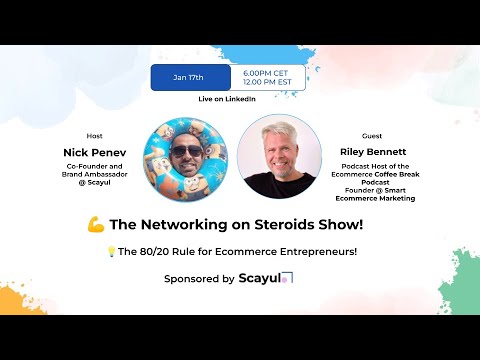


In this podcast episode, we discuss the 80/20 Rule for Ecommerce Entrepreneurs and how you can implement it for quick results. Our podcast host Claus Lauter was interviewed on Nick Penev's podcast at scayul.com.
Topics discussed in this episode:
- How ecommerce entrepreneurs can practically implement the 80/20 rule to identify which aspects of their business should be prioritized.
- What some actionable steps are that businesses can take to outsource or delegate the 80% of tasks that aren't producing substantial outcomes.
- How the concept of "owned marketing" versus "paid marketing" can be balanced to build a sustainable audience.
- How eliminating "time bandits" and "energy vampires can improve productivity.
Chapters/Timestamps:
04:39 80/20 rule: Originally engineering observation, widely applicable now.
07:35 Focus on key areas for maximum results.
10:44 80/20 rule enhances decision-making, efficiency, productivity. Cut distractions for greater success.
14:28 Analyze strategies with 80/20 rule for efficiency.
16:40 Focus on the 80/20 rule for happiness.
19:55 Self-learning tasks before delegating to experts.
23:43 Balance swag group distractions with important tasks.
27:51 Find audience, connect on appropriate platforms.
30:12 Avoid free giveaways, attract the right audience.
Links & Resources
Website: https://scayul.com/
Website: https://smart-ecommerce-marketing.com/
LinkedIn: https://www.linkedin.com/in/nick-penev-0051791a/
LinkedIn: https://www.linkedin.com/in/clauslauter/
About Our Podcast Guest: Claus Lauter
Claus Lauter, a 20+ year eCommerce veteran, Shopify & Klaviyo Partner, and award-winning store owner. Also, a certified Google expert. Named Top 20 Shopify Expert in 2022, he hosts the Ecommerce Coffee Break Podcast, a top-ranked Shopify podcast. An international entrepreneur with ventures in the USA, Germany, South Africa, and Singapore. Passionate about entrepreneurship and digital marketing, he's visited 60+ countries, lived on three continents.
Nick Penev, Co-founder of Xtreme Power brands, created and sold 20+ Supplement brands in Europe by 2020. He transformed XTREME POWER into a Partnership as a Service agency for eCommerce providers, aiding growth through strategic partnerships. Hosted/speaking in 200+ eCommerce webinars, podcasts, and events. Also, Co-founder of Scayul - a proactive introductions and referral swaps SaaS tool!
Listen & Subscribe on your Favorite Podcast App:
Apple Podcasts | Spotify | Amazon/Audible | Google Podcast | YouTube
Please support the show if you liked today's episode:
- If you love the podcast, please get someone else to listen, too!
- If you enjoyed this episode of the Ecommerce Coffee Break podcast, please head over to Apple Podcasts, leave a rating, write a review, and subscribe.
- Share the podcast with your family, friends, and co-workers.
- Tag the podcast on Instagram @clauslauter and let me know what you like about it.
- If you like the content and would like to support the podcast, you can buy me a coffee here.
- Become a guest on the show or sponsor an episode.
Claus Lauter [00:00:00]:
This bonus episode is a recording of.
Claus Lauter [00:00:02]:
My interview with Nick Penev on his podcast at Scayul.com.
Claus Lauter [00:00:05]:
And we discussed the 80 20 rule for ecommerce entrepreneurs and how you can.
Claus Lauter [00:00:09]:
Implement this into your business for quick results. So let's get started.
Claus Lauter [00:00:14]:
But before we get started, a big thank you to our sponsors for supporting today's episode.
Claus Lauter [00:00:19]:
Loyalty lion is a leading loyalty platform helping Shopify brands rocket returning customers with their own loyalty programs. With Loyalty lion, it's quick and easy to create a program that uses points and rewards to engage shoppers, secure more second purchases, and drive up lifetime value. Loyalty lion has been increasing returning customer rates for thousands of Shopify stores for over ten years. Visit loyaltylion.com to find out more. Find the link in the show notes.
Claus Lauter [00:00:45]:
Have you heard about partner Hero? They're experts in support on the ecommerce industry, known for their outstanding team building skills. Their main pillars, quality people and culture makes them a great fit for your company. Learn more on partnerhero.com or click the link in the show notes.
Voice over [00:01:01]:
This is.
Voice over [00:01:02]:
The e commerce Coffee Break, a top rated Shopify growth podcast dedicated to Shopify merchants and business owners looking to grow their online stores. Learn how to survive in the fast changing e commerce world with your host, Klaus Lauter, and get marketing advice you can't find on Google. Welcome.
Claus Lauter [00:01:26]:
Welcome to the show.
Nick Penev [00:01:27]:
Hello everyone. This is Nick Penev again with our second show of the year for Scale networking on steroids. Today we have a very interesting guest. He's going to talk about the topic that I have no idea what it is about, but the topic would be 80 20 rule for ecommerce entrepreneurs with Kwao Swalter. He is the host and the producer of the ecommerce Coffee Break podcast and newsletter. He has 15,000 people who read his newsletter and listen to his podcast, so he has a lot to share with you guys. But before we do that, we're going to mention our sponsor, Scale. I am the co founder of Scale Extreme Power brands and a partnership advisor of over 40 companies in decommer.
Nick Penev [00:02:07]:
What scale does is it provides practice, referrals and introductions for people in any industry. So instead of waiting for the opportunity to come, you meet partners. You upload your contacts or partners required there. You share the link of your partners and you ask the other party to request interactions and vice versa. So your connections are your currency. So we simply facilitate the introduction swaps between people. We just need to upload your contacts, you share them with the other partner on your end and you just start doing swaps for client partners, whatever you would like to do. But the main point is that you're doing warm introduction swap, so the conversion rate and the rate of people booking meetings much higher.
Nick Penev [00:02:48]:
So check it out. We're going to share how to sign up. We're going to give away one free account for a month. But right now we're going to talk more about the topic and let me bring our guest today to the stage. Hey Kwals, you have a super cool topic. So I'm really curious to know more about you because I know some stuff. But right now you're going to tell us more and you're going to tell us about the 80 20 rule, which I suspect what would be about. And I think this is something that a lot of people in ecommerce in general need.
Nick Penev [00:03:16]:
But tell us more about you and you can just give us more tips about your topic. So thanks again.
Claus Lauter [00:03:24]:
Thanks first of all for having me on the show today. I'm really pumped about talking about the 80 20 rule. Maybe a quick background about myself. I'm an entrepreneur digital marketer for over 20 years. I host, as you said, and produce the ecommerce Coffee Break podcast, which is a podcast where I interview world class experts, founders and thought leaders in ecommerce marketing and AI, mainly discuss topics around how to grow your business on and with Shopify. I'm also a slow nomad, which means I'm slowly traveling around the world. And Nick, I know you're a big traveler as well. I have lived on three continents, visited 60 plus countries, and right now I'm in born as Iris in Argentina.
Claus Lauter [00:04:01]:
As for the 80 20 rule, that's something that came on my mind during my entrepreneurial journey. And most people might have heard about the 80 20 rule. It's also called the Pareto principle, or the law of the vital few and the useful money. So to understand how it works, I want to go a little bit into the history how the Pareto principle came up. It was developed by a name called Wilfredo Pareto in 1896. He had nothing to do with digital marketing. He has nothing to do with entrepreneurship or ecommerce. He was an economist, and he observed that 80% of the land in Italy was owned by 20% of the population.
Claus Lauter [00:04:39]:
So that's where it started. Many years later, in 1941, Joseph Duran, a romanian born american engineer, applied this observation of the 80 20 rule to quality issues. So he basically bought it into production, into engineering, and from there, it got its life on his own. So nowadays, if we are looking from the ecommerce side from the digital world into the 80 20 rule. The most common rule that most people know about is that, for instance, 80% of your revenue of your results will come from 20% of your product. That's something that a lot of people know about. But there is other rules that you can apply, and the best way to start for yourself, either in your private life or in your business life, to apply the 80 20 rule is to look at different areas. So that can be, for instance, in marketing, might be that 20% of your marketing activities bring you 80% of your clients, and that's something you potentially want to find out.
Claus Lauter [00:05:42]:
So you want to dive deeper into that and really see and do an assessment or an edit or an audit of what you do, and to find out what is actually the most profitable activity that I have. The 20% that bring me 80% of my clients, and then focus on these 20% instead of the 80% that basically are just a waste of time.
Nick Penev [00:06:04]:
That's actually a very good thing, because in partnerships, that's what I'm telling everybody, because partnership is my business. I run the agents in the network. It's all about partnership. This is what I tell everybody. You need to find 100 partners, because in the end, you're going to end up doing stuff with 20 of those which are going to deliver even higher than 8%. So usually this is the case. But what we're talking about is very important because people usually give up too early before even trying. So I'll let you continue.
Nick Penev [00:06:31]:
But that's exactly how it is in partnerships.
Claus Lauter [00:06:35]:
Then as a good example for the 80 20 rule, I will just go through another couple of examples, because I think examples are the best way to understand how you can apply the 80 20 rule to your business. One thing that happens quite often is that 80% of your complaints are coming from 20% of your customers, which has a nice effect. If you want to really make a decision there, you might go as far as firing these 20% of your customers because they might just take too much time away from you. I mean, if these are valid complaints, obviously you should look into that as well. But same for customer support. 80% of the questions that are coming, or of the customer support requests are coming in are 20% of the questions that are coming in. And with that specifically in ecommerce, you can address this quite quickly and free up time for your customer support agents and find these 20% of returning questions that are coming in all the time. They are basically taking 80% of their time and address this already in your online store, in your customer communications.
Claus Lauter [00:07:35]:
To give you an example there probably the most common question is when will my package, my product arrive? That potentially is 80% of all things that are coming in. So you don't want to get as far as people really addressing your customer agent, your support agent, who is that? That's something that you want to find a way either through an app, through an AI whatever to address this already and then just freeing up your time. Another thing that you can talk about is that 20% of the input that you create creates 80% of the results that you have. Or in other words, 20% of your workers produce 80% of your results. So you want to look into your team, into your workforce and really see who produces most of the results. And is there anything that you basically can help them to cut out activities, 80% of activities that do not produce results. So in the course saying the 80 20 rule, and it does not necessarily to be 80 20, it can be 1090 or 70 30. But there's always something in your business that you should focus on and see, okay, this is really what brings most of my results or of my pain, and then try to focus on these ones and the other 80% that are giving little results or no results at all you want to cut out.
Claus Lauter [00:08:53]:
Or if it's necessary for your business, you want to find a way to outsource that to give it to someone else. Reason for that is either it might be cheaper or it might be someone who is better in dealing with these 80%, not only cheaper, but be more focused on it and squeezing more out of it.
Claus Lauter [00:09:13]:
And now a quick break to thank the sponsors of today's episode.
Claus Lauter [00:09:17]:
Tired of watching customer drift away after their first purchase? Then it's time to rocket your returning customer rates and drive six times more second purchases. With loyalty line as a leading loyalty platform in the Shopify space, loyalty line exists to make it as easy as possible for you to launch and manage your own loyalty program. They'll even build your loyalty page for you. With loyalty line, you unlock everything you need to engage shoppers with points and rewards and integrate loyalty data into your email, SMS and help desk platforms. You also get a five star support as shown by the customer reviews on the Shopify App Store and g two. Visit loyaltyline.com to find out more and start your loyalty journey. Find the link in the show notes.
Claus Lauter [00:09:56]:
As a prominent player in the ecommerce support arena, partner here rule specialize in delivering personalized customer experience solutions with a clear focus on helping you not just meet but exceed your goals and requirements. They have become experts in e commerce support. Their commitment to tailoring solutions to your unique needs ensures that your support experience is nothing short of exceptional. Partner Hero is more than a CX company. They are your partner in success. Visit their website and learn more on partnerhero.com.
Nick Penev [00:10:22]:
The examples that you're giving are very good because sometimes people struggle with some stuff which is not important. And probably now if they apply these rules, they can actually optimize a lot of parts of their business. And I assume even wife, because business and wife, they have a lot in common. So do you have some examples in wife? For example, for the 80 20 rule, not necessary.
Claus Lauter [00:10:44]:
But I mean, obviously the 80 20 rule in general helps you to make better decisions during a problem solving process. So whenever you look at a problem, you try to focus as, okay, what are the things that really make it work? And what are the things that do not make it work now as the benefit why we are looking into it, there's a couple of definitely advantages of using the priority principle. So obviously you might be able to create a greater productivity, better efficiency of using your time and your energy. You will definitely become better in your problem solving skills by applying this all the time. And also you might improve your decision making skills because now you know what you need to look at and you know that that's the point where you need to make a decision. So with that, you can prioritize your work better. And two things that I have learned in my life as an entrepreneur, and it's actually advice that I got from a business angel very early when I started my first company 20 years ago, is cut out time bandits and energy vampires. So time bandits is either a person or tasks that steals you time.
Claus Lauter [00:11:50]:
So you want to find out, and again, 80 20 rule, you find out what that is and just try to get rid of it. And trying to get rid of it means give it to someone else. As an entrepreneur. And I see that with coaching clients that I had in the past, a lot of them have the shiny objects syndrome. A lot of them are all over the place all the time, and they do a lot of things that they are either not good at it or not motivated in doing it. So then this is the point where you really need to make a cut and say, okay, I need to outsource that and find someone else who is better than me. And then you have energy vampires. And these are just tasks that drain your energy, and it's potentially something you're just not suited for.
Claus Lauter [00:12:27]:
I'll give you an example. I have a basic understanding of bookkeeping, of accounting. I'm a solopreneur. I do my bookkeeping myself. I know how it works, but it drains my energy. It's just something I don't like to do once I'm going through the tasks. It's necessary to do that. You can't cut that out of a business, but it drains my energy.
Claus Lauter [00:12:46]:
I feel that. So it gives you just an example on what things you need to focus on, maybe a little bit more. And you don't need to do that permanently and every day, all the time for certain tasks. For instance, with the example that I gave you earlier with the customer support, you do it once a month. You just look into your data and see, okay, what's the 20% of returning customer requests that are coming in that are taking away time from my agents? And how can I make that better.
Nick Penev [00:13:14]:
For the accounting and bookkeeping? I don't think there is people who like to do that. And a lot of business owners know, they don't even know their numbers. So that's probably not the 80 20 in the reverse. Sometimes they spend 80% in growing the business and they don't spend the 20% to see if the business is profitable. So that's why using this rule, they probably need to outsource to somebody and instead of just wasting their time to. And that's actually a common thing in Amazon. Amazon Shopify, probably the same people usually sell and they have no idea if they're profitable or not. And the reason why they don't, they're either doing it themselves or they have the wrong partner for that.
Nick Penev [00:13:53]:
So actually, it's a very good rule. By the way, I think you gave.
Claus Lauter [00:13:57]:
A good example there. Coming back to bookkeeping, the 20% that you need is your KPIs. That's your report, that's your balance sheet. That's what you need as an entrepreneur. These are the 20% that are really important, the 80% to put it into a system and to prepare it for your tax returns and whatever that can be done by someone else. So that means when it comes to accounting, bookkeeping, don't do it on your own, but just focus on the 20% that in your business make a difference. And that's where you make your decisions. So that's your balance sheet, that's your reporting, and so on and so forth.
Claus Lauter [00:14:28]:
Other examples there would be, for instance, to ask yourself, what are the top 20% of the audience that I want to reach out there, or where is the 20% of my web traffic coming from that generates 80% of the sales. So looking really into your sales strategy, for instance, Facebook ads, Google Ads, something that pretty much every entrepreneur out there runs and should run. But there you want to look into what are the 20% of ads that I have that give me 80% of the results or more? A lot of solopreneurs, small or medium enterprises, I know they either outsource paid ads to an agency or they just started, and then every week or ten days they look into it. And that's something that if you run it on your own, you should actually do every day and then really figure out what are the 20% that make big difference and then cut out everything else. So you see there's a lot of different areas where you can apply the 80 20 rule. But I said, you don't need to do that permanently every day. Just take a bigger batch or an area of your business and then look at it with the 80 20 rule in mind, and then try to make a decision how you can optimize that when it comes to employees. For instance, I'm a business partner with a company that's called smartecommercemarketing.com.
Claus Lauter [00:15:49]:
And that's where it comes to outsourcing, where we basically take over the 80% of necessary work, for instance, like the bookkeeping or the marketing creation whatsoever, that are necessary but are not the most important 20% that should stay with the business owner.
Nick Penev [00:16:06]:
As you were chatting, I did a quick check on one of my clients partnership dashboard. We have 600 partners, and like 20% of the partners are actually generating the whole revenue. It's exactly what you said, and I've been telling that, but just from my observations. But I never knew that there is a rules, and I just checked that and it's confirmed. It's a large number of people, like 600 partners. It's even almost exactly 20% is what I checked.
Claus Lauter [00:16:40]:
As I don't focus so much on the 20%. It can be 10%, it can be 30%, but there's always a smaller percentage in that range that makes all the difference. And I think that the key factor to take away from our call today is to really have the mindset, the 80 20 mindset, and look with that kind of thought process at your business and then try to go through it step by step and sort out it helps tremendously. And also, and I think that's very important, it will make you happier at the end of a day because you can focus on the things that you enjoy and you can focus on the things that are showing results. And then obviously with that you will be happier and you will feel less burnt out. If you're all over the place, obviously you're burnt out. Your brain is jumping back and forth. And I have been there, believe me, more than once.
Claus Lauter [00:17:30]:
So you really start getting a mindset of focusing on the things that matter. And then obviously you need to apply that to a stage or to a step where you start outsourcing to give things away or completely get rid of things. I mean, if you're doing marketing and 80% of your marketing is not working, then probably you need to cut out a lot of things.
Nick Penev [00:17:52]:
Yeah, actually, and this is one of my goals, by the way, for 2024 because I do a lot of stuff, very well organized. But this, I run agency network SaaS and right now I'm going to start doing a newsletter and YouTube channel. So I'm going to start delegating a lot of tasks from my team because I can do all of that myself. But like I said, I'm going to be spending a lot of time for stuff that I shouldn't be doing. And that's probably not how everybody should use stuff. And I've seen probably the most successful people that I've met. They know their limits and they kind of delegate and that's what they're saying. Okay, delegate as early as possible.
Nick Penev [00:18:31]:
If you think that you're the best in something, you're wrong. There is always somebody who is better than you and who can actually do it even for you or do it better. So that's important. Do you have actually any tips for the educational partner when you're teaching people? Can you apply that in a case, for example, from, let's say, for hiring people? Because that's one of your business. When you hire people, is there such a rule? 20% of the candidates are actually a good fit for what you're looking for or there is no such thing for hiring people.
Claus Lauter [00:19:03]:
That's a very good question and it shows you focusing on the things that you're good in. I'm not good in hiring. I never was. So I always had someone by my side who can do that for me and doing this much better. I'm actually absolutely not qualified to give any information about a hiring process. I'm an entrepreneur for a very long time. I hire people by a completely gut feeling, which is probably not the best thing to do. That's part of it.
Claus Lauter [00:19:27]:
But obviously there's other things that apply to hiring people. And so I can't help on that one. But I think what makes sense there, and that's something that was 20 something years of entrepreneurship I learned, is delegating. And you said that is very, very important. It's not always easy. Specifically, if you start your own business, you want to have control over everything, and so on and so on, you start to micromanage. And specifically, if you have employees and you're micromanaging all the time, they don't like that. So that will be not a very nice atmosphere.
Claus Lauter [00:19:55]:
But I think, and that's one of my strongest principles that I carry in business life is, and you mentioned that is I do every task in my business. Whatever I come up with in the beginning, I do it myself for a certain point because I want to understand the process. Give you an example, Google Ads, Facebook ads, TikTok ads, whatever it is. So in the beginning, I try to learn the process. I try to figure out how it works, and I do it for myself as far as I can for a while. And then I find someone who's better than me, and there's always, always someone who's better than me. But the biggest advantage, the biggest takeaway that you have from that is if you have done it for yourself for a while, you can talk to the person that you hire. That might be either an internal employee, a freelancer agency, or whatever.
Claus Lauter [00:20:39]:
You can talk to them on eye level so they can't tell you any kind of, sorry, my french bullshit stories, because you have done it. So you know the topic, and that gives you a much better position in negotiating, in talking generally about the topic with them. If you have a general understanding, if you have never done any kind of paid ads, and then you hire an agency running your ads for your money, they can tell you everything, you take it as it is. So that's why it is important as an entrepreneur, small medium business to have a general understanding and then outsource and then focus on the 20% to come back to the pareto principle on the 20% that you like and that you're good at. Because as you said, no one is good at everything.
Nick Penev [00:21:26]:
Yeah. By the way, when you mentioned the hiring, I have also very unique way of hiring. I never put like job posts or I never eat cvs usually. No, I hire people when they try to sell me something or people that I've worked with. So I kind of test them and I tell them, okay, do this small task. You're going to be hired. And with my way of hiring there is a 99. 1% rule.
Nick Penev [00:21:50]:
99. Don't bother to do anything. The 1% are the guys that I hire. But this shows me which guys are open in practice. For example, whenever I chat with people, I'm going to put them in my newsletter. I'm going to connect them with people and tell them, okay, the only thing that you need to do is just sign up for my newsletter. And some people don't even bother with that. So how can you expect something who you're giving a lot of value? They just need to do one small favor for you to sign up for your newsletter.
Nick Penev [00:22:16]:
They don't do that. Or for example, I tell somebody, okay, send me a short introduction about yourself. I'm going to connect you with ten guys. Some of them might become quiet. Some people never bother to do that. So it's actually a very quick way to filter people. I'm going to do a favor for you. I'm going to help you out.
Nick Penev [00:22:34]:
You need to help out yourself. I'm not believer. I don't believe. I'm not religious, but no, they have it in the Bible. If you want God to help you out, help yourself first. So if you're not doing any effort, how do you expect that you're going to get something in return? That's off topic, but it's actually part of that. Sometimes people, the small things make the big results. So I think that's partially like 28 rule.
Nick Penev [00:22:57]:
You do small steps, get big results. You don't do anything. There is a sink. Nothing comes out from doing nothing.
Claus Lauter [00:23:07]:
But I think you said it's like the 1%. So we're not talking about now, we're talking about the one to 99% rule. But again, the 1% who signed up for the newsletter or who did the tasks, that's the one that you want to focus on. That's the one where you want to hire. So it's the same. So it's less about the percentage number, it's more about the mindset for you to find out what works and then really go deep into what works. And the rest you cut out. You give someone else or whatsoever.
Claus Lauter [00:23:36]:
A lot of people are just all over the place and they're trying to solve all the problems in the same time, which obviously doesn't work.
Nick Penev [00:23:43]:
Yeah, I mean, you're right about that. Because sometimes even I catch myself because I'm in four or five big WhatsApp swag groups and people ask for help and sometimes I get distracted and I spend a lot of time actually helping because I'm like that. If you would like to be connected, I'm going to connect you. But sometimes, wife said, you need to prioritize, do the important stuff first, then you're going to help them out. They're not going to go anywhere. So that's why also delegating is good, but I guess organizing yourself, spend 8% of the time for the most important part of what you're going to generate. So tell us about building a podcast and a newsletter, because a lot of people have no idea how valuable is that 80 20 principle. Can you apply that in building quite an audience?
Claus Lauter [00:24:31]:
I think you can. Now, building an audience, I think nowadays is very important. Speaking for ecommerce, obviously a returning customer is far cheaper and much more valuable than acquiring a new customer. That's the one thing talking about ecommerce now, when we're talking about generally an audience, whatever that is, that might be either that you're selling something, you have a profit, or in my case, running a podcast is in the case of a newsletter. You own the audience, you have the data, you have the subscribers, you have the email addresses and whatever. So that's owned marketing. If you're running Facebook ads or Google Ads, meta ads, whatever you want to call them, you're building your house on rented land. It's paid marketing.
Claus Lauter [00:25:12]:
In the moment when either the algorithm changes or they change their policies, you might be offered. So building your own audience is time consuming. It takes a lot of time. It takes a lot of building trust that people sign up for you and stay with you. But it's definitely the most valuable audience that you can have and you get a lot of feedback from that. Now, my podcast, I in the lucky position to talk to a lot of very smart people. And for me as a podcast host, it helps to be not the smart person on the call because I learn a lot. So they are founders, they're startup founders, they're developers.
Claus Lauter [00:25:48]:
They talk about AI, ecommerce marketing. So with every call that I have, I learn something new, which is great. I love learning. But I also try to put myself in the position of my listeners because I want to ask the questions they would potentially ask my guest so that they can learn from that too. It's a slow process. It takes quite some time. I'm doing the podcast for, I don't know, about two years, a little bit more than two years now. And the audience is growing and the feedback that I get is very good.
Claus Lauter [00:26:18]:
And it gives me also more ideas on how to grow the audience and where to find my audience because I'm in the same situation. I have to apply the 80 20 rule. I'm doing marketing for the podcast as well to promote the show. And I need to find obviously ways to get to potential new listeners, people that don't know about the show and might be interested. And that's also trial and error. And then focusing on the 20% that hopefully bring me new subscribers.
Nick Penev [00:26:47]:
How do they actually market that to find new subscribers? I know what they don't mind. For example, I do webinars, I do the show. Like today we have people who sign up, then we put them in the newsletter. So what are you using on your end to get in front of new people? Like new potential subscribers?
Claus Lauter [00:27:06]:
Yeah. So different ways there. One way is obviously being a guest on other people's show, like Today on your show, which I really appreciate. You can do the same with newsletters, obviously you can do newsletter swaps or newsletter ads to be in a newsletter of someone else who already has your audience. So you do this kind of co marketing that can be either a promotion swap or you buy an ad on someone else. You can also buy audio ads on other podcasts because then people are already on the medium. And then obviously you can do the whole range of paid ads to try to get people on. That works particularly good with newsletter subscribers, to find them on meta, on Instagram, on Facebook, on threads, on Twitter, or x as it's called now.
Claus Lauter [00:27:51]:
So you can reach out on other platforms. But the best way to grow an audience is to find them on the medium, on the channel that is your channel. So finding a podcast subscriber, the best way is to be already on another podcast, because then you know already they're listening to podcasts or are on YouTube. If you have a YouTube channel, newsletter subscribers to grow a list, you can go far broader. That's because you have your newsletter subscriber form somewhere where people can sign up and that can be basically on every channel. I think really you need to find out who's your audience, really ask your audience who they are. Sometimes you have the perception of that, you know who your listener is, your podcast is, and then you do reach out and the results coming back, you say, oh yeah, that's someone totally different, but they're still interested in you. So you need to change your marketing.
Claus Lauter [00:28:38]:
So the better your understanding is of your audience, of your listener, of your customer, the higher the likelihood is that they sign up for your newsletter or follow you on your YouTube channel or on your podcast.
Nick Penev [00:28:49]:
Okay, close. And because we're almost done. Can you give the people who are going to watch the show like 80 20% hack how they can quickly implement that in what they're doing if they no idea where to start.
Claus Lauter [00:29:02]:
If you're selling a product or service, look into your sales numbers and try to find out the 20% of your customers that bring you 80% of your sales. That might give you some ideas who that is profile wise. And then focus on these 20% to make your business bigger.
Nick Penev [00:29:20]:
Okay. That's an extremely valuable tip. See what are your ideal clients like for a SaaS solution? Like for ecom, see who they are and what you're doing right with them and see if you can actually change for the other ones, I guess. And so I accept feedback. No, feedback is the most important part. How important is feedback actually running any.
Claus Lauter [00:29:41]:
Kind of business, it's number one. You need to have customer feedback.
Nick Penev [00:29:45]:
So let's say if you're starting a new business, like a brand or a product or a service, would you advise those people to actually do giveaway? Either a lot of free products or to give away free subscriptions so they can actually get feedback first? Because some people are wondering, are we ready? Are we not? So do you think that's the best way? Give people, actually get users, get clients, see what they say and just go from there?
Claus Lauter [00:30:12]:
No, I'm not a big fan of free giveaways because you attract the wrong kind of people. You attract freebie seekers, and they might not be necessarily your audience. If you start and you have no clear idea who your customer is, look at your competitors. It's very seldom that you start a business where there is no competitor around. If you have, congratulations. But normally there is others who are at least in the field that you're operating in. And then look at your competitors and try to find out who are their customers, who's their audience, where is your competitor doing marketing? And that gives you an idea about the potential customers. Once you have the first ones, then obviously feedback, reaching out and learning more from them is the next step.
Claus Lauter [00:30:54]:
But I wouldn't try to bribe people into new business by giving out freebies or something because I said usually you attract the wrong kind of person.
Nick Penev [00:31:04]:
Okay, thanks, Klaus. And I think we're done. So I'm going to mention briefly again our sponsor, mycompany scale. It's kind of unique, by the way, Klaus. So we knew who is a good fit, but we need to educate people. So right now we need to educate like 80% of our audience so we can actually have 20% of them to be paid plans. But I didn't know about this crew and we're going to apply it more. But for anybody who is watching listening to us, make sure that you use that.
Nick Penev [00:31:32]:
Check your numbers, because at the end, everybody's doing that to make some money. And the profit is the most important part. So see if this rule applies to you. If not, work on those numbers and see where you're doing it wrong. So if you enjoy our show, I strongly recommend to connect with quals. We're going to feature the recording in our newsletter so we can watch it there and you'll be able to connect with him. And I strongly recommend to sign up for his newsletter and for his podcast because he has a lot of great guests. And of course, if you're the right fit, you can actually connect with me and I can connect you with Kwaus.
Nick Penev [00:32:08]:
He's on my skill page. So thank you again everybody for joining us today. And like I said, if you have any questions, get in touch with Kauls, get in touch with me. If you enjoy that, recommend us to other people, but keep doing partnerships. Connect with people and you're going to do what we did today. We met a month ago because we're connected by a partner. We did some partner swaps. Now, I was a guest at Klaus podcast.
Nick Penev [00:32:32]:
He's a guest in Minec. There is no money involved. Pure partnerships. That's how it's done. So thanks again Klaus for joining today. And we're going to go backstage to chat for some other stuff. Adios everybody.
Claus Lauter [00:32:44]:
Thanks. Goodbye. Hey Klaus here. Thanks for joining me on another episode.
Claus Lauter [00:32:49]:
Of the e commerce Coffee Break podcast.
Claus Lauter [00:32:51]:
Before you go, I'd like to ask.
Claus Lauter [00:32:52]:
Two things from you. First, please help me with the algorithm so I can bring more impactful guests on the show. It will make it also easier for others to discover the podcast simply like comment and subscribe in the app you're using to listen to the podcast, and even better if you could leave a rating. Secondly, please take a moment to check out today's episode sponsors. They play a crucial role in keeping the show in our newsletter available to you for free.
Claus Lauter [00:33:14]:
Thanks again and I catch you in the next episode. Have a good one. Before you leave, don't forget to visit.
Claus Lauter [00:33:18]:
The sponsor of today's episode. Have you heard about partner Hero? They're experts in support on the e commerce industry, known for their outstanding team building skills. Their main pillars, quality people and culture makes them a great fit for your company. Learn more on partnerhero.com or click the.
Claus Lauter [00:33:33]:
Link in the show notes Loyalty lion is a leading loyalty platform, helping Shopify brands rocket returning customers with their own loyalty programs. With Loyalty lion, it's quick and easy to create a program that uses points and rewards to engage shoppers, secure more second purchases, and drive up lifetime value. Loyalty Line has been increasing returning customer rates for thousands of Shopify stores for over ten years. Visit loyaltyline.com to find out more. Find the link in the show notes.
Episode Sponsors

Rocket your returning customer rates with LoyaltyLion. LoyaltyLion is a leading loyalty platform, helping Shopify brands increase returning customer rates with their own integrated loyalty programs. We were the first loyalty platform to integrate with Shopify and we are #1 on G2 today, providing the tools and expertise that brands need to increase returning customer rates, improve retention, and build customer lifetime value. Visit LoyaltyLion here.

Enhance your eCommerce business with PartnerHero. Our comprehensive support solutions, which include 24/7 customer assistance, expert marketplace insights, and self-service infrastructure, will empower your brand’s customer experience. We prioritize exceptional customer service, maintaining language standards, multi-channel support, and user/system assistance. Visit us at: https://pages.partnerhero.com/ecommerce-coffee-break Talk to us, and lets create a tailored customer support solution for you!
Get notifications when new episodes are released. Unsubscribe anytime.
In your inbox for free. Every Thursday. Consumed in 3 minutes or less. Join over 5,000 Ecommerce Merchants, Founders, and Marketers.