Partner With Us. Reach 70K Ecom Operators. Learn more Ecommerce Coffee Break Podcast and Newsletter

Ecommerce Coffee Break Ecommerce Coffee Break
  • HOME
  • PODCAST
    • Browse All Episodes
    • Playlists By Topic
    • Be a Podcast Guest
    • Suggest a Guest
  • NEWSLETTER
    • Subscribe
    • Past Issues
    • Advertise
  • PARTNERS
  • PARTNER WITH US
    • Be a Podcast Guest
    • Advertise/Sponsor
  • REVIEWS
    • Reviews
    • Rate on Apple Podcasts
    • Rate on Spotify
  • SUBSCRIBE
    • Email Newsletter
    • Apple Podcasts
    • Spotify
    • YouTube
    • iHeart
    • Amazon Music
    • Overcast
    • Castbox
    • Podurama
    • RSS Feed
  • ABOUT US
  • HOME
  • PODCAST
    • Browse All Episodes
    • Playlists By Topic
    • Be a Podcast Guest
    • Suggest a Guest
  • NEWSLETTER
    • Subscribe
    • Past Issues
    • Advertise
  • PARTNERS
  • PARTNER WITH US
    • Be a Podcast Guest
    • Advertise/Sponsor
  • REVIEWS
    • Reviews
    • Rate on Apple Podcasts
    • Rate on Spotify
  • SUBSCRIBE
    • Email Newsletter
    • Apple Podcasts
    • Spotify
    • YouTube
    • iHeart
    • Amazon Music
    • Overcast
    • Castbox
    • Podurama
    • RSS Feed
  • ABOUT US
  • Home
  • Content Hub
  • European Fulfillment Strategy: 4 Steps to Scale Cross-Border

Content Hub

17 Apr

European Fulfillment Strategy: 4 Steps to Scale Cross-Border
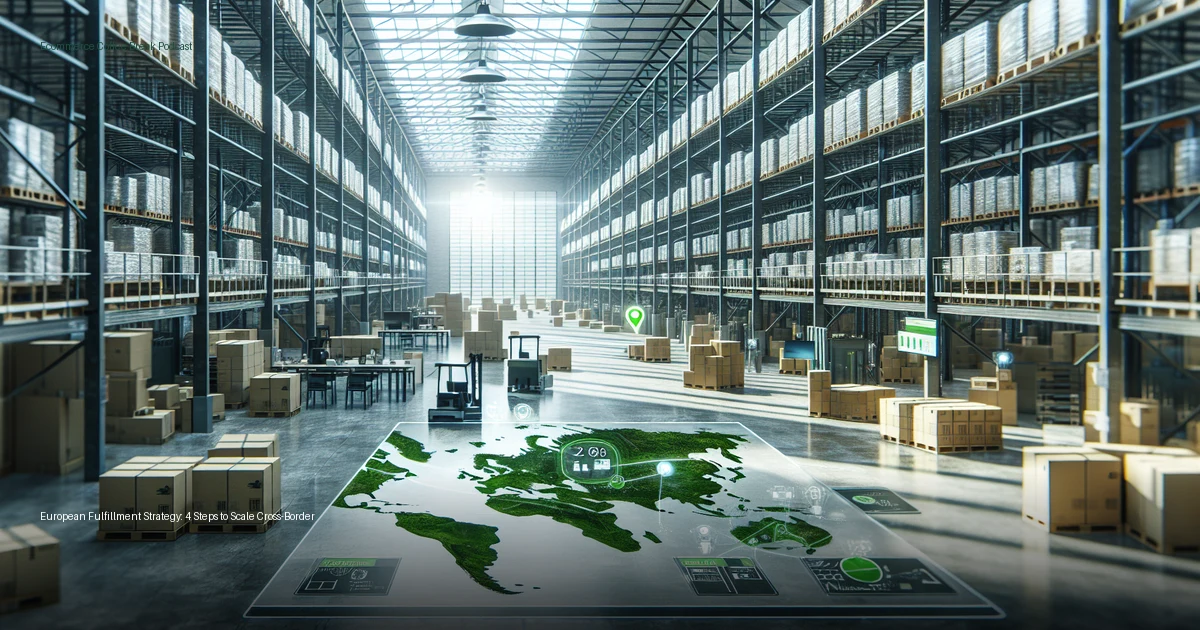
A successful European fulfillment strategy requires treating the EU as 27 distinct markets rather than a single country, implementing regional distribution centers for cost-effective delivery, and adapting to local consumer preferences for payment methods and packaging. The key is partnering with fulfillment providers who understand these regional nuances and can deliver sustainable, localized experiences that build customer trust.

Understand Europe’s Market Fragmentation Reality

The biggest mistake businesses make when expanding into Europe is assuming the European Union operates as one unified market. In reality, your European fulfillment strategy must account for 27 different countries with distinct consumer behaviors, payment preferences, and delivery expectations.

Consider payment methods alone: while Northern European consumers rarely use cash on delivery, Greece maintains a 45% cash on delivery rate, Poland sits at 30%, Czech Republic at 20%, and Italy still processes around 20% of orders this way. Your fulfillment partner needs systems to handle these payment variations seamlessly.

Regional carrier preferences also vary dramatically. Some countries heavily favor parcel locker stations, while others expect traditional doorstep delivery. A robust European fulfillment strategy incorporates these preferences rather than forcing a one-size-fits-all approach.

Language localization extends beyond your website to fulfillment operations. Return instructions, delivery notifications, and customer service communications should be available in local languages—not just English—to maximize customer satisfaction and reduce return friction.

Implement Regional Distribution for Cost and Speed

Regional distribution centers are the backbone of an effective European fulfillment strategy. Rather than shipping internationally from a single location, strategic placement of inventory across Europe dramatically reduces costs and delivery times.

The economics are compelling: shipping a 1kg parcel from Poland directly to Spain might cost €10, but routing that same package through a regional Spanish hub brings the cost down to €4—using the same final-mile carrier. This approach makes ecological shipping affordable rather than premium-priced.

Your European fulfillment strategy should prioritize road transport over air freight whenever possible. Road delivery is both more cost-effective and environmentally sustainable, typically adding only 1-2 days to delivery times compared to expensive air freight options.

When selecting regional distribution points, consider your product category and target demographics. Highly innovative tech products often perform better when launched in Nordic markets where consumers embrace new technology, while fashion items may find better initial traction in Southern European markets.

Build Sustainability Into Your Competitive Advantage

Sustainable packaging and logistics practices are no longer optional in European markets—they’re becoming a competitive differentiator that directly impacts customer loyalty and return rates.

“E-commerce is not an ecological business as such, and as any business, we pollute. But it’s all about taking things serious and trying to reduce as much as we can waste and use right materials,” explains Rolando Casanova from Internel.eu.

Your European fulfillment strategy should eliminate plastic packaging wherever possible, transitioning to materials made from renewable sources like sugar cane or corn starch. However, sustainability extends beyond materials to sourcing—corn-based packaging from local European suppliers often has a smaller carbon footprint than sugar cane materials shipped from Latin America.

Clean, well-branded sustainable packaging creates a positive unboxing experience that customers associate with your brand values. This physical touchpoint—often the first real-world interaction customers have with your brand—can determine whether they become repeat buyers or leave negative reviews.

Sustainable logistics also means optimizing shipping routes and consolidating orders when possible. Regional fulfillment centers naturally support this goal by enabling shorter shipping distances and reduced carbon emissions per package.

Navigate Legal and Operational Requirements

Before launching your European fulfillment strategy, you’ll need to establish proper legal and tax infrastructure within the EU. This isn’t optional—it’s required for legitimate operations and customer trust.

Every business selling into Europe needs an EU-based office or virtual office for product responsibility purposes. This can be established quickly and affordably, but it’s essential for handling returns, customer service, and legal compliance. European consumers prefer buying from companies with local presence rather than overseas entities.

You’ll also need an EORI (Economic Operators Registration and Identification) number for customs purposes and VAT registration for tax collection. The one-stop-shop VAT system has simplified this process, but you’ll still need a local agent or service provider to manage compliance across different EU markets.

Your European fulfillment strategy must include multilingual customer service and return processes. Customers expect to receive support in their native language, and this extends to return labels, instructions, and dispute resolution. Quality fulfillment partners typically offer support in 20+ European languages.

Product compliance requirements vary by category and country. Sensitive products like dietary supplements or electronics may require additional certifications or restrictions in certain markets. Factor these requirements into your market entry sequence and product positioning.

Key Takeaways

  • Europe consists of 27 distinct markets with different consumer preferences, payment methods, and delivery expectations that require localized fulfillment approaches.
  • Regional distribution centers can reduce shipping costs by up to 60% while improving delivery times and environmental sustainability.
  • Sustainable packaging materials and practices are becoming competitive requirements in European markets, not optional add-ons.
  • Legal infrastructure including EU office registration, EORI numbers, and VAT compliance must be established before launching European operations.
  • Multilingual support across fulfillment operations, from delivery notifications to return processes, significantly impacts customer satisfaction and retention.
  • Road transport through regional networks offers better cost-effectiveness and environmental impact compared to international air freight shipping.
How much can regional distribution centers reduce shipping costs in Europe?
Regional distribution centers can reduce European shipping costs by up to 60%, such as cutting costs from €10 to €4 for a 1kg package. This is achieved by converting international shipments to domestic delivery rates within each country.
 
What legal requirements do I need to sell in Europe from outside the EU?
You need an EU-based office (can be virtual), an EORI number for customs, and VAT registration for tax collection. These requirements ensure legal compliance and build customer trust with local presence.
 
Why do payment methods vary so much across European countries?
European consumers have distinct cultural preferences for payment methods, with cash on delivery rates ranging from 0% in Northern Europe to 45% in Greece. Your fulfillment strategy must accommodate these regional preferences to maximize conversions.
 
This article is based on insights shared by Rolando Casanova on the Ecommerce Coffee Break Podcast. Listen to the full conversation: Europe Shipping SECRETS: Sell More & Save the Planet — Rolando Casanova
Tags:3pl servicescross border ecommerceeu expansioneuropean fulfillmentSustainable Packaging
  • Share:
Ecommerce Coffee Break Podcast

Search Site

LISTEN ON

Apple Podcast itunes Spotify

YouTube Logo Overcast Logo

Castbox Logo Podurama Logo

iHeart Radio Subscribe by Email

Latest Episode

How to Build Customer Loyalty Through Product Innovation — Nathan Yun | How Product Innovation Drives Loyalty, What Paire Learned From Buyer Feedback, Why Brands Focus on Customer Retention, How Fabric Tech Solves Apparel Issues (#506)
12Oct,2026

SUPPORT OUR PARTNERS

XERO
Bizrate Insights
Free Ecommerce Guides

Rankings & Awards

FeedSpot Logo
Global-Podcast-Rank

Who should we interview next? Who would make a great guest? Let us know.

Suggest a Guest

The Ecommerce Coffee Break — The B2B Media Platform Built to Connect the Ecommerce Industry. Discover the sales and marketing strategies top ecommerce brands actually use to grow revenue faster.

Get the Free Newsletter for Ecommerce Operators
  • Home
  • About
  • Episodes
  • Partner with Us
  • Newsletter
  • Rankings & Awards
  • Media Kit
  • Community
  • Guest Application
  • Content Hub
  • Contact
  • Free Resources

LISTEN ON

  • Apple Podcasts
  • Spotify
  • Amazon Music
  • YouTube Music
  • Castbox
  • RSS Feed
  • iHeart Radio

Follow on Social

LinkedIn Claus Lauter Facebook Claus Lauter Twitter Claus Lauter Instagram Claus Lauter YouTube Claus Lauter

☕ 100% powered by caffeine and curiosity. Disclaimer: The Ecommerce Coffee Break is independent media not affiliated with or endorsed by Amazon™, Shopify™, or any third party.

© 2019–2026 idube Pte Ltd. All Rights Reserved.

  • Home
  • Privacy
  • Terms
  • Disclaimer
  • Cookie Policy
  • Imprint
  • Sitemap
Manage Consent
To provide the best experiences, we use technologies like cookies to store and/or access device information. Consenting to these technologies will allow us to process data such as browsing behavior or unique IDs on this site. Not consenting or withdrawing consent, may adversely affect certain features and functions.
Functional Always active
The technical storage or access is strictly necessary for the legitimate purpose of enabling the use of a specific service explicitly requested by the subscriber or user, or for the sole purpose of carrying out the transmission of a communication over an electronic communications network.
Preferences
The technical storage or access is necessary for the legitimate purpose of storing preferences that are not requested by the subscriber or user.
Statistics
The technical storage or access that is used exclusively for statistical purposes. The technical storage or access that is used exclusively for anonymous statistical purposes. Without a subpoena, voluntary compliance on the part of your Internet Service Provider, or additional records from a third party, information stored or retrieved for this purpose alone cannot usually be used to identify you.
Marketing
The technical storage or access is required to create user profiles to send advertising, or to track the user on a website or across several websites for similar marketing purposes.
  • Manage options
  • Manage services
  • Manage {vendor_count} vendors
  • Read more about these purposes
View preferences
  • {title}
  • {title}
  • {title}
Manage Consent
To provide the best experiences, we use technologies like cookies to store and/or access device information. Consenting to these technologies will allow us to process data such as browsing behavior or unique IDs on this site. Not consenting or withdrawing consent, may adversely affect certain features and functions.
Functional Always active
The technical storage or access is strictly necessary for the legitimate purpose of enabling the use of a specific service explicitly requested by the subscriber or user, or for the sole purpose of carrying out the transmission of a communication over an electronic communications network.
Preferences
The technical storage or access is necessary for the legitimate purpose of storing preferences that are not requested by the subscriber or user.
Statistics
The technical storage or access that is used exclusively for statistical purposes. The technical storage or access that is used exclusively for anonymous statistical purposes. Without a subpoena, voluntary compliance on the part of your Internet Service Provider, or additional records from a third party, information stored or retrieved for this purpose alone cannot usually be used to identify you.
Marketing
The technical storage or access is required to create user profiles to send advertising, or to track the user on a website or across several websites for similar marketing purposes.
  • Manage options
  • Manage services
  • Manage {vendor_count} vendors
  • Read more about these purposes
View preferences
  • {title}
  • {title}
  • {title}

Become a smarter online seller in 3 minutes

Free weekly newsletter read by 15,000+ Shopify merchants, Amazon sellers, and DTC brands.

Join 100% free • Twice a week • Unsubscribe anytime