

Ecommerce Platform Optimization Before Replatforming
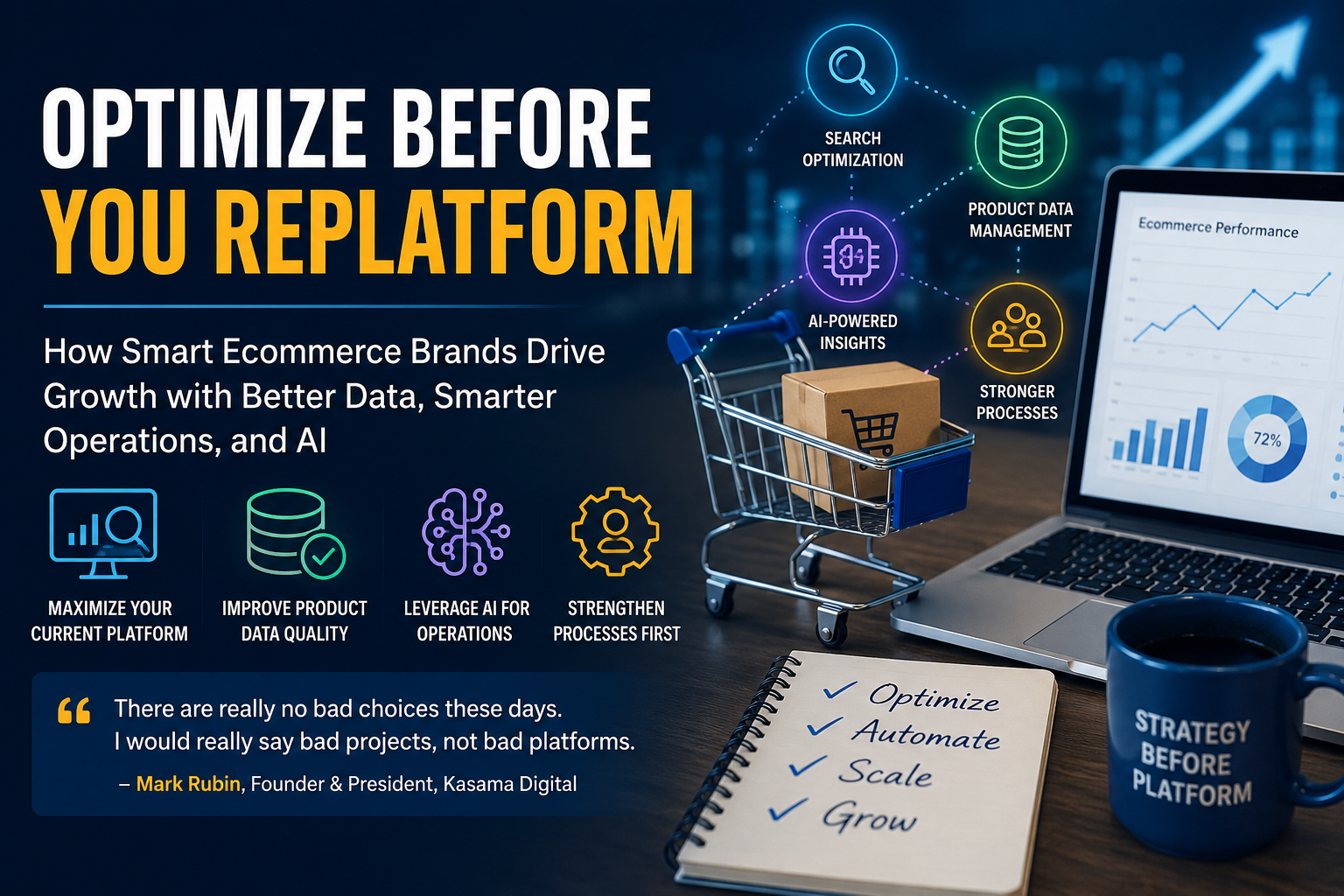
Why Smart Ecommerce Brands Optimize Before They Replatform
For many ecommerce companies, a platform migration feels like the next logical growth step. But according to Mark Rubin, Founder and President of Kasama, most brands are nowhere near maximizing the tools they already pay for. Before investing heavily in a migration project, brands should focus on ecommerce platform optimization, product data quality, and operational workflows that directly impact revenue and efficiency.
Direct Answer
The best ecommerce brands do not rush into replatforming projects. Instead, they focus on ecommerce platform optimization by improving product data, maximizing existing platform features, and fixing internal operational bottlenecks first. According to Kasama founder Mark Rubin, most ecommerce issues come from poor implementation and disconnected processes rather than the platform itself.
1. Ecommerce Platform Optimization Should Come Before Replatforming
One of the most actionable insights from the conversation is simple: many brands are trying to solve operational problems with a new platform instead of improving how they use their current one.
That distinction matters.
Modern ecommerce platforms like Shopify, Salesforce Commerce Cloud, WooCommerce, and Adobe Commerce already offer highly advanced functionality. Search, promotions, content management, integrations, AI capabilities, international selling tools, and app ecosystems have become increasingly similar across platforms.
Mark Rubin explained that when brands approach Kasama about a replatforming project, the first step is usually an audit.
According to Mark Rubin, many ecommerce brands are not fully using the search, content, promotion, and merchandising capabilities already available inside their current platform.
That audit often reveals a surprising reality:
- Search tools are poorly configured
- Promotional systems are underused
- Content workflows are inconsistent
- Apps overlap in functionality
- Teams lack proper operational processes
- Customer data is fragmented
Rubin made another important observation during the interview: “There are really no bad choices these days. I would really say bad projects, not bad platforms.”
That statement reflects a major shift in ecommerce technology.
Five or ten years ago, platform limitations created significant competitive differences. Today, the biggest problems are often operational rather than technical.
Before investing in a costly migration, brands should first evaluate:
- Whether their current platform features are fully enabled
- How well internal teams actually use the system
- Whether operational workflows create bottlenecks
- If customer and product data is properly structured
- Which apps or integrations create unnecessary complexity
In many cases, optimizing existing systems produces faster ROI than a complete migration.
2. Product Data Is Becoming the Most Important Ecommerce Asset
One of the strongest themes throughout the discussion was the growing importance of structured product data.
As AI shopping tools become more advanced, clean product information is becoming a competitive advantage.
AI systems depend on high-quality product data to generate useful results. That includes:
- Product titles
- Descriptions
- Attributes
- Specifications
- Categories
- Tags
- Inventory information
- Metadata
Without structured data, even advanced AI systems produce inconsistent or inaccurate outputs.
Rubin specifically highlighted the rising importance of PIM systems (Product Information Management platforms). He suggested that brands planning AI investments should prioritize product data cleanup before spending heavily on AI tools themselves.
That recommendation is more practical than many brands realize.
Right now, ecommerce teams are experimenting with:
- AI-generated product descriptions
- AI search engines
- Recommendation systems
- AI merchandising
- Conversational shopping tools
- Marketplace automation
But weak product data quietly limits all of these systems.
If sizing information is inconsistent, attributes are incomplete, or categories are poorly organized, AI tools struggle to understand the catalog correctly.
Brands serious about ecommerce platform optimization should invest in:
- Consistent product taxonomy
- Centralized product information management
- Attribute standardization
- Duplicate data cleanup
- Structured metadata workflows
- Cross-channel product consistency
This becomes especially important for large catalogs with tens of thousands of SKUs.
Rubin shared examples of businesses managing massive product libraries, including highly niche ecommerce companies selling replacement scooter parts, regulated products, healthcare-related items, and specialty industrial products.
As ecommerce AI evolves, brands with clean product data will move faster than competitors trying to organize fragmented catalogs later.
3. AI Is Already Reshaping Ecommerce Operations
Much of the public conversation around AI focuses on marketing content. But operational AI may create even larger long-term gains for ecommerce companies.
Kasama began introducing AI into workflows more than three years ago. According to Rubin, many clients initially resisted the idea. Today, the opposite is true.
Rubin explained that clients now expect agencies to actively use AI tools to improve speed, efficiency, and project delivery.
Kasama currently uses AI across several operational areas:
- Development acceleration
- Documentation creation
- Workflow support
- Communication optimization
- Team collaboration
- Language improvement using Grammarly
This operational approach is important because many ecommerce teams still view AI only as a content generation tool.
In reality, AI can improve:
- Internal project management
- Customer support workflows
- Product data organization
- Technical documentation
- Developer productivity
- Operational consistency
One particularly interesting insight from Rubin was how quickly AI adoption changed client expectations.
Three years ago, some clients rejected AI usage entirely. Now, agencies risk losing business if they are not actively using AI-powered workflows.
That shift shows how rapidly ecommerce operations are changing.
The companies gaining the most value from AI are not necessarily the ones using the most advanced tools. They are the ones integrating AI into practical daily workflows.
4. Most Ecommerce Problems Are Actually Process Problems
Another recurring theme throughout the conversation was the importance of people and process.
Rubin repeatedly emphasized that technology is rarely the true bottleneck.
Instead, most ecommerce challenges come from:
- Poor communication
- Unclear ownership
- Weak operational workflows
- Misaligned priorities
- Disconnected teams
- Lack of internal processes
Rubin described a framework Kasama uses internally:
People → Process → Technology
In other words, technology should support a strong operational structure — not replace one.
This becomes especially important during replatforming projects.
Many ecommerce managers already juggle multiple responsibilities. Adding a migration project creates enormous pressure on internal teams.
Rubin described replatforming as highly stressful even when experienced agencies and enterprise partners are involved.
That stress comes from managing:
- Customer data migration
- Order history transfers
- SEO preservation
- Promotions and discounts
- Integrations
- Content management
- Staff training
- Operational continuity
One major lesson from the conversation is that brands should not underestimate the operational side of ecommerce infrastructure.
Technology alone rarely fixes broken workflows.
Key Takeaways
- Most ecommerce platforms already offer advanced capabilities that brands fail to fully utilize.
- Product data quality is becoming critical for AI-driven ecommerce operations and search systems.
- Successful ecommerce platform optimization often delivers faster ROI than a full replatforming project.
- AI is creating operational improvements in development, documentation, workflows, and communication.
- Many ecommerce failures are caused by weak processes and implementation rather than platform limitations.
- PIM systems are becoming increasingly important for brands managing large or complex product catalogs.