

Why the Next Generation of Ecommerce Winners Will Be Defined by Profitability, Not Revenue
| TL;DR
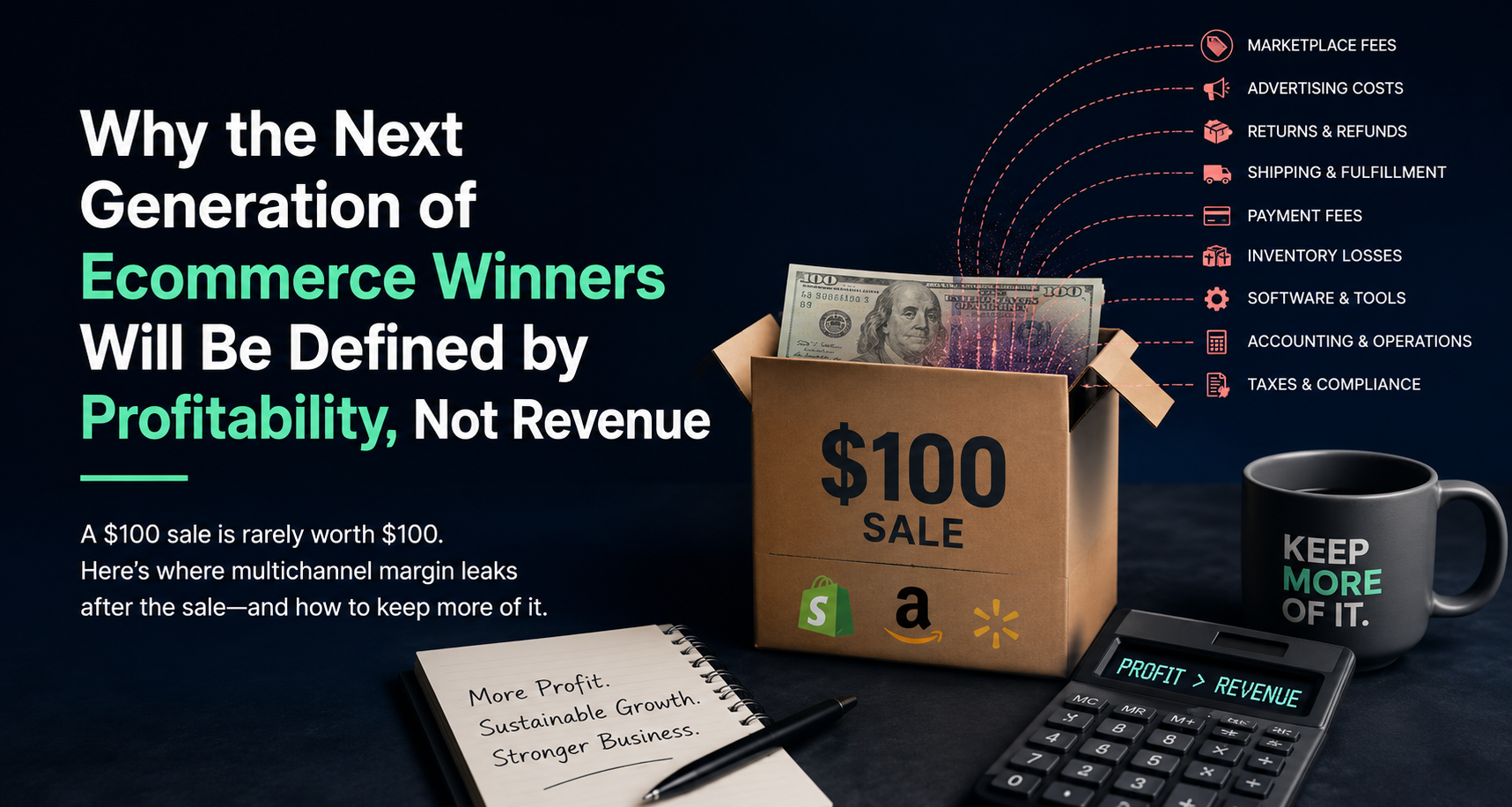
Most ecommerce businesses don't have a sales problem, they have a profit leakage problem. Revenue can grow while profits stay flat because every sale loses money in dozens of small ways: marketplace fees, advertising, returns, inventory errors, accounting inefficiencies, and operational complexity. The next generation of winning ecommerce brands won't necessarily sell more. They'll understand where every dollar goes after a sale and keep more of it. |
Starting is easy. Selling is hard. Keeping is close to impossible.
A founder can launch a Shopify store in an afternoon, connect Amazon over the weekend, and be selling nationally within days. The barriers that used to keep people out of ecommerce have mostly disappeared, and that's a genuinely good thing. More people building businesses is good for everyone.
Selling is a different problem, and a harder one. Getting someone to buy requires product, positioning, paid acquisition, and a supply chain that doesn't fall over the first time volume spikes. Most founders figure this part out eventually. It's painful, but it's learnable, and the market tells you quickly when you're getting it wrong.
Keeping the money is the part almost nobody talks about, and it's the part that actually determines whether the business survives. So that's what this piece is about; not how to sell more, but how to keep more of what you've already earned.
| Who’s this guide for: Multichannel operators doing roughly $1M–$20M across Shopify, Amazon, and other channels, the point where hidden coordination costs start quietly eating real money. |
What is ecommerce profitability?
Ecommerce profitability is the amount of profit a business retains after accounting for every cost required to acquire, fulfill, deliver, support, and account for a sale. Unlike revenue, profitability measures what the business actually keeps.
A profitable ecommerce business doesn't simply sell products. It consistently converts sales into sustainable earnings.
That requires understanding every cost involved in selling online, including:
- Cost of goods sold (COGS)
- Marketplace and platform fees
- Payment processing fees
- Shipping and fulfillment
- Returns and refunds
- Advertising costs
- Inventory carrying costs
- Software subscriptions
- Finance and bookkeeping
- Operational overhead
- Taxes and compliance
Many of these expenses don't appear obvious when looking at Shopify dashboards or marketplace deposits.
That's why businesses often overestimate how profitable they actually are.
Why a $100 sale is never really worth $100
A $100 sale does not mean $100 of usable revenue, and it doesn't lose money the same way twice.
Here is the same $100 sale sold through two different channels.
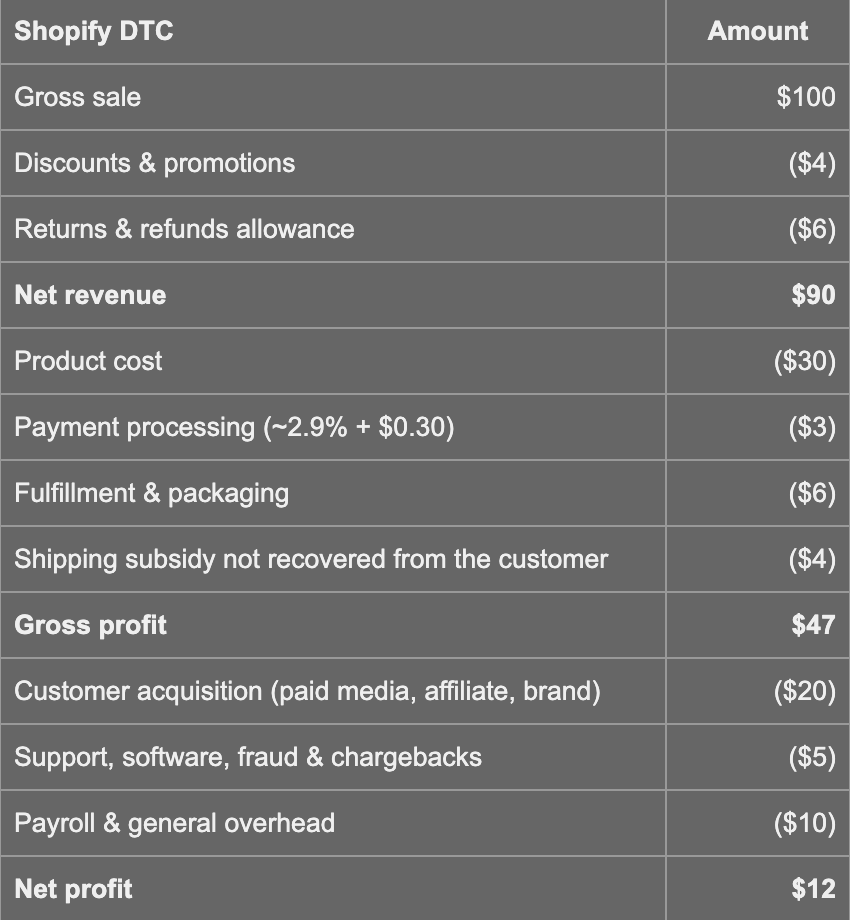
Typical Shopify DTC brand at 12% margins.
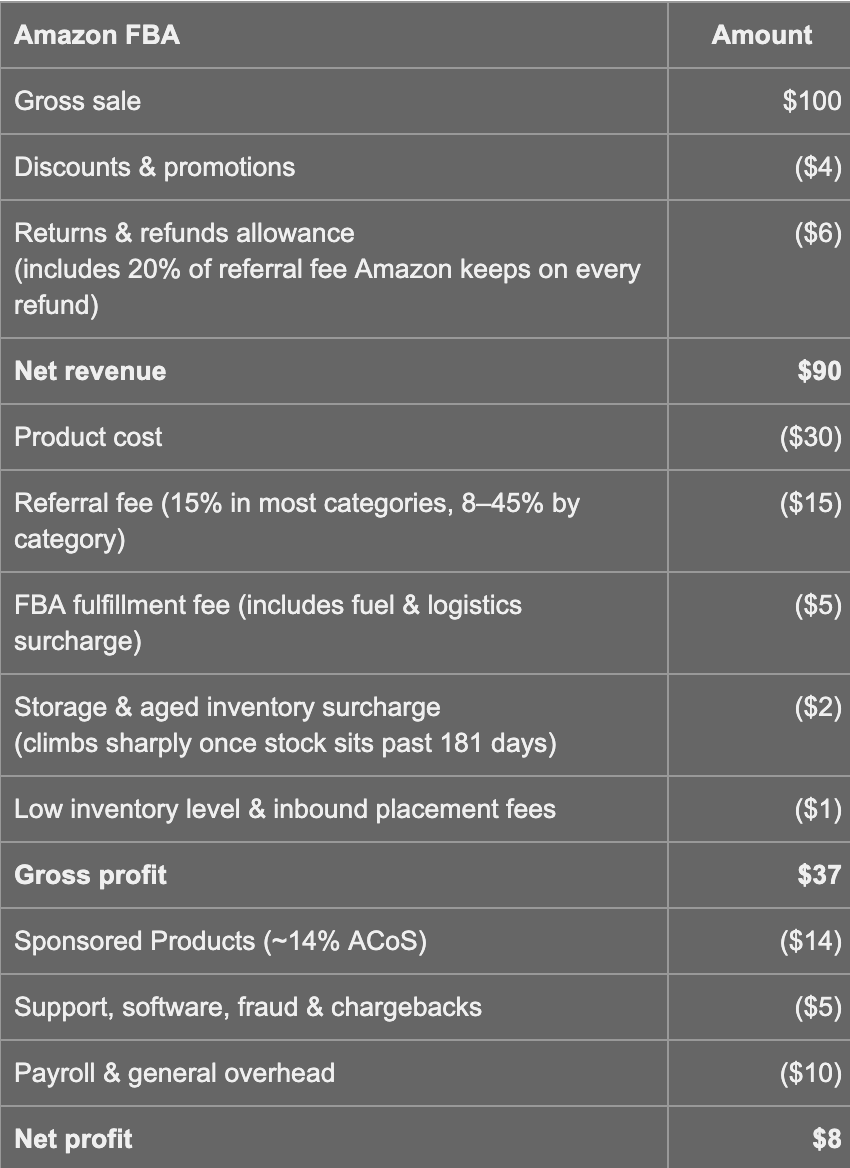
Typical Amazon seller at 8-20% margins.
Typical Shopify DTC brands often operate around 12-20% net margins, while Amazon sellers typically land somewhere between 8–12%, depending on category, fulfillment model, and advertising costs.
The same $100 sale can produce very different outcomes.
Shopify vs. Amazon: Where the money goes
Shopify
- Higher customer acquisition costs because you have to bring shoppers to your store.
- Lower platform and transaction fees.
- Greater control over customer relationships and data.
- Higher potential margins if acquisition costs are managed well.
Amazon
- Lower customer acquisition costs because shoppers already have buying intent.
- Higher platform costs through referral fees, FBA fees, storage, placement, and advertising.
- Less control over the customer relationship.
- Margins can shrink quickly as marketplace fees increase.
An operator looking only at a blended P&L, or worse, a lump-sum bank deposit, would never see how different these two businesses actually are once every dollar is accounted for.
Nothing on either list is unusual, and none of it is a mistake the founder made. It's simply what selling through each channel costs.
Even a 12% net margin is a strong outcome.
Many multichannel sellers operate on even thinner margins without realizing it because the number they review every month isn't actually their true margin.
One point of margin beats another million in revenue
A few days ago I read Daniel Kornum’s piece, “AI's Biggest Winners Have the Lowest Margins,” which argues that AI's biggest economic impact may land not inside software companies, but inside industries that have run on thin margins for decades: manufacturing, logistics, staffing, and distribution.
Ecommerce belongs on that list.
Take a business doing $5 million annually across Shopify and Amazon, averaging roughly 9% net margin. That's about $450,000 in annual profit.
Recover one additional point of margin and there's suddenly another $50,000 in the bank:
- No additional customers.
- No additional products.
- No higher ad spend.
The business didn't grow. It simply stopped losing money it had already earned.
See what you're leaving on the table. Enter your order volume and sales channels into the Margin Leak Calculator to estimate how much profit a 1% improvement in margin could put back into your business.
So where does that missing margin go?
Most founders assume lost margin comes from advertising, fulfillment, or inventory. Those certainly matter. But one category receives surprisingly little attention:
The operational cost of coordinating ecommerce data
Every order creates work that has nothing to do with making the sale.
- It has to match a marketplace settlement
- Fees need to be allocated correctly
- Inventory movements need to reconcile across systems
- Refunds must connect back to original payouts
- Accounting records must agree with operational data
Nobody gets paid because accounting is difficult. They get paid because a dozen different systems all describe the same transaction differently, and someone has to make them agree.
What multichannel coordination actually costs (Example)
For a typical $5 million multichannel apparel business, the hidden coordination burden can look something like this:
| Cost Area | Annual Impact |
| Manual reconciliation & month-end close | $15k–35k |
| Finance & bookkeeping effort | $20k–60k |
| Fee misclassification | $5k–20k |
| Inventory discrepancies | $5k–30k |
| Refund & return mismatches | $2k–10k |
| Duplicate or missing transactions | $2k–15k |
| Management investigation time | Difficult to quantify |
| Poor decisions from incomplete data | Potentially hundreds of thousands |
Notice something interesting? Most of these costs never appear as their own line item on the P&L. Instead, they appear as:
- Margins that slowly decline
- Month-end close takes longer every quarter
- Finance teams living in spreadsheets
- Founders spend hours investigating numbers instead of growing the business
- Decisions based on incomplete or inaccurate reporting
These are all forms of profit leakage.
The trade-off ecommerce teams have quietly accepted for years
Here's where the industry has been solving the wrong problem.
Operators need granular operational data to make good decisions: SKU-level margins, channel profitability, real-time inventory, product-level performance. Without that detail, every decision becomes a guess dressed up as strategy.
But granularity creates exceptions. And exceptions make accounting messy. So businesses end up choosing between two imperfect options:
| Option | The downside |
| Granular operational data | Books rarely reconcile cleanly |
| Clean, summarized books | Critical operational insights disappear |
Most ecommerce businesses have accepted this trade-off without ever realizing they were making one.
The 4-step framework to keep more of every sale
Improving profitability isn't about one big change, it's about fixing the small leaks that add up over time:
1. Measure profit, not just revenue
Revenue shows what's selling. Profit shows what's working. Track profitability by channel, product, and SKU to understand where you're actually making money.
2. Capture every cost
A sale includes far more than the product price. Marketplace fees, payment processing, shipping, advertising, returns, and operational costs all affect your true margin. Connect these costs to every order.
3. Automate routine work
Manual reconciliation slows month-end and increases the risk of duplicate transactions, missing sales, and accounting errors. Automating repetitive tasks improves both speed and accuracy.
4. Focus on exceptions
Don't review every transaction manually. Let routine transactions flow automatically and surface exceptions like settlement discrepancies, unusual refunds, or inventory mismatches for human review.
And AI alone won't fix ecommerce accounting problems!
Ecommerce operations are inherently complex, and accounting isn't something you can simply "prompt" into automation.
An AI model can identify that a settlement looks unusual. It can highlight missing transactions. It can surface patterns.
But it shouldn't decide whether a fee belongs in cost of goods sold or operating expense.
It shouldn't determine whether a timing difference is acceptable or whether a reconciliation issue represents an actual accounting error.
Those are business-specific judgment calls that require human accountability.
| 💡Note: Automation should accelerate accounting, not replace accounting judgment. |
Removing the trade-off with automation and expert review
This is exactly the problem we've spent years solving at Webgility. Rather than accepting a trade-off between operational detail and clean accounting, Webgility is designed to support both.
The platform automates order-level accounting across ecommerce channels, payment processors, inventory, and accounting software, while built-in exception handling ensures transactions that need review don't silently create inaccurate books.
| Take BeeCure, a skincare brand selling on both Amazon and Shopify. As order volume grew, so did the time required to reconcile sales, marketplace settlements, fees, and accounting records. Their finance team was spending nearly a full week every month just making the numbers agree.
After connecting their sales channels to QuickBooks through Webgility, month-end reconciliation dropped from a week to just one or two hours. The business didn't sell more products or raise prices. It simply eliminated hundreds of hours of manual coordination each year, giving the team faster financial visibility, fewer reconciliation errors, and more time to focus on growing the business instead of chasing transactions. |
That's what recovering margin actually looks like in practice. Instead of choosing between summarized reporting and operational visibility, operators keep both: summarized and order-level-detail:
- Detailed order- and SKU-level financial data
- Automated sync across sales channels and accounting systems
- Exception workflows for transactions that need human review
- Faster reconciliations without sacrificing accuracy
The goal isn't just to automate bookkeeping. It's to help businesses understand exactly where every dollar goes after a sale is made.
Connect your channels and your accounting system, we'll show you where the money is going after the sale.
Authors Bio: Vikram Bhaskaran
Vikram Bhaskaran is the CMO at Webgility, where he leads marketing strategy and growth initiatives. He enjoys building adaptive marketing models, shaping vision, and listening closely to customers to uncover their Zero Moment of Truth (ZMOT).