

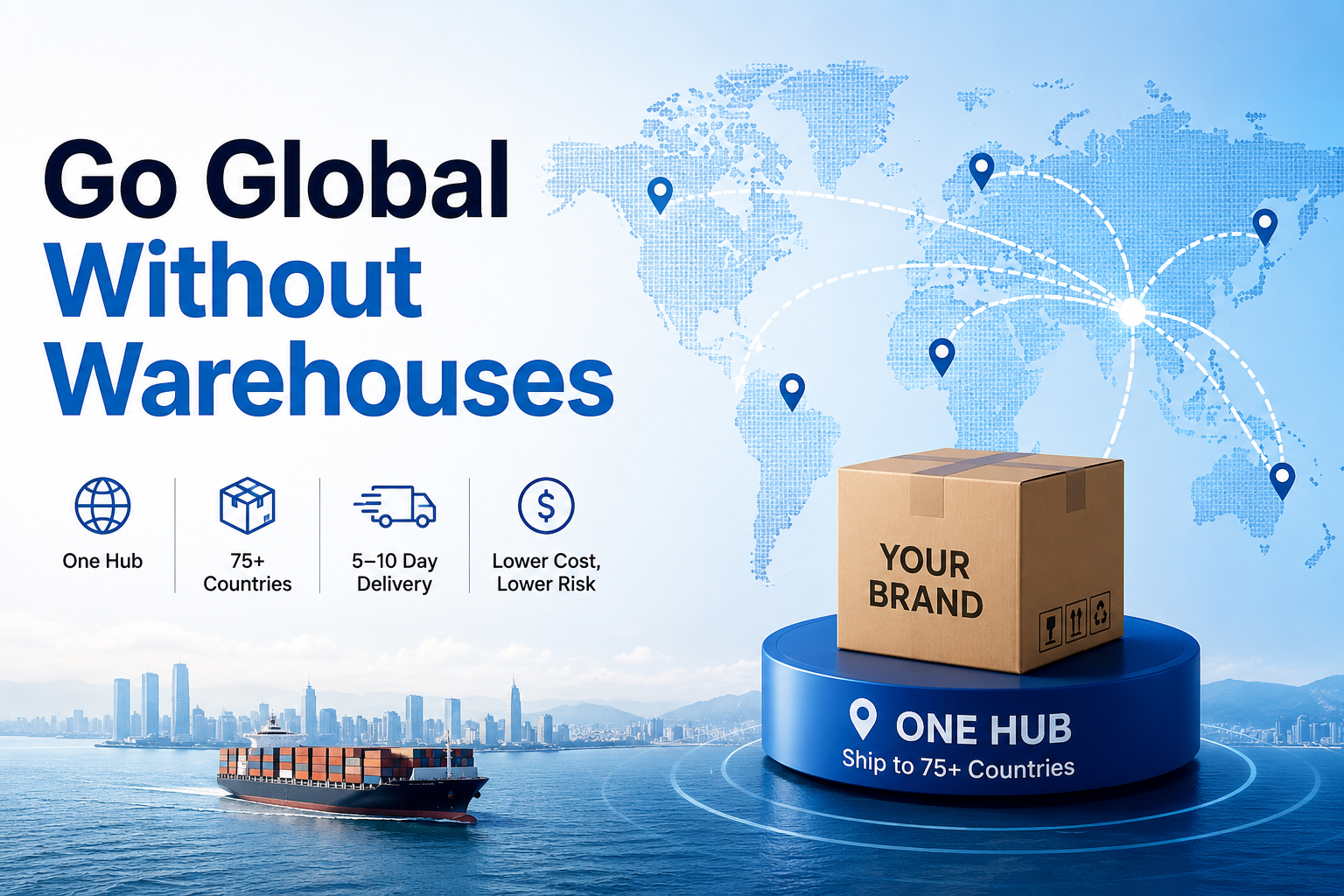
Go Global Without Warehouses
How to Expand Your Ecommerce Brand Internationally Without Opening a Single Warehouse
Brands can expand ecommerce internationally without warehouses by consolidating inventory into a single cross-border fulfillment hub and shipping directly to customers in dozens of countries using local last-mile carriers.
This model, pioneered by companies like Portless, eliminates the need to open, staff, and negotiate separate 3PL contracts in every new market. Instead of splitting stock across regions, brands keep one inventory pool near their manufacturing base and let cross-border logistics handle delivery in five to ten days almost anywhere in the world.
Why the "Warehouse in Every Country" Model Is Outdated
For two decades, international ecommerce expansion meant one thing: open a warehouse. Want to sell in the UK? Find a 3PL, sign a new contract, negotiate rates, and hope demand justifies the fixed cost. Want Australia too? Repeat the entire process again. This is exactly the trap Portless founder and CEO Izzy Rosenzweig says most brands fall into, and it's the single biggest reason founders delay going global for years longer than they need to.
The traditional model creates four compounding problems:
- Fragmented inventory. Stock gets split across multiple warehouses, so a strong seller in one region can sit dead in another with no easy way to rebalance.
- Locked-up cash flow. Every unit sitting in a regional warehouse is capital that isn't funding new product, marketing, or growth.
- Operational sprawl. Different 3PL contracts, different billing systems, and different support teams multiply the admin burden with every new country.
- No easy exit. If a market underperforms, pulling inventory back out of a warehouse is slow, expensive, and often treated as an afterthought during contract negotiations.
None of these problems are actually about demand. Rosenzweig is direct about this: brands assume international customers aren't there, when in reality the demand already exists — it's the fulfillment model that's holding brands back from reaching it.
This misconception shows up especially strongly among US-based brands, according to Rosenzweig. The US market is large enough on its own that many founders never feel pressure to look beyond it, so international expansion gets filed away as a "someday" project rather than a near-term priority. The irony is that the same operational complexity that scares off US brands — different carriers, different customs rules, different currencies — is precisely the layer that a cross-border fulfillment partner is built to absorb. A brand based in Australia, the UK, or the US all face the identical structural question: how do you reach buyers outside your home market without duplicating your entire logistics stack for each one? The answer doesn't change based on where the brand started.
The Cross-Border Fulfillment Model: One Hub, Global Reach
The alternative to opening warehouses in every market is to consolidate everything into one cross-border facility positioned close to where products are actually made. Portless operates two such facilities, in China and Vietnam, which allows brands to move inventory out of a two-month ocean shipping cycle and into a two-day intake process at the hub. From there, a single pool of inventory can service more than 75 countries using local last-mile carriers rather than international postal networks alone.
Here's how the mechanics actually work for a brand making the switch:
- One inbound point. Goods go from factory to the cross-border facility (Portless even offers factory pickup as part of onboarding) instead of splitting shipments to multiple regional warehouses.
- Order-level routing. When an order comes in from any of the 75+ supported countries, the last-mile label is applied at the hub and the parcel is routed on outbound pallets and flights out of Hong Kong or mainland China.
- Local delivery experience. Despite shipping from a single hub, the end customer gets a domestic-feeling delivery experience — average delivery times run around six days to the US and five and a half days to the UK.
- Shared inventory across markets. The same stock used to serve your core market is the stock that serves every other market. If Canada isn't converting, you simply stop directing inventory there — no warehouse lease to unwind, no local contract to exit.
This is the structural shift that lets a brand expand ecommerce internationally without warehouses in each region: instead of managing five inventory pools and five sets of vendor relationships, a brand manages one.
What This Means for Cash Flow and Risk
Cash flow is where the model has the most immediate business impact, and it's worth separating from the delivery-speed story. Under the traditional warehouse-per-market approach, a brand has to make a purchasing decision for every region months in advance, tie up capital in inventory sitting in a building it now leases, and absorb the risk if that market underperforms. Under the cross-border hub model, inventory is pooled and only allocated to an order once a customer actually buys — nothing is pre-committed to a specific country's warehouse shelf.
That difference matters more than it sounds. A few practical outcomes brands see from this shift:
- Lower dead-stock risk. Since inventory isn't earmarked for a specific country's warehouse, a slow market doesn't leave you holding stranded stock.
- Faster testing of new markets. Turning on a new country becomes a routing decision rather than a warehouse-opening project, so brands can test demand in weeks instead of quarters.
- Healthier working capital. Rosenzweig points to a consistent pattern across Portless's client base: brands that never actively sold outside their core market typically see roughly 40% of their revenue come from international orders within 12 months of turning it on — revenue that required no new warehouse investment to unlock.
- Simplified compliance. Tax and duties questions, one of the biggest psychological blockers to going global, get handled through the fulfillment partner rather than requiring a brand to build in-house expertise for every jurisdiction.
Izzy Rosenzweig's core argument is that most ecommerce brands have the going-global equation backwards: the real risk isn't expanding into new markets, it's staying confined to a single country while competitors already capture the international demand sitting right in front of them.
A Practical Onboarding Path for Brands Considering This Model
Brands evaluating a cross-border fulfillment partner should expect a structured, multi-stage process rather than a simple sign-up. Based on how Portless runs onboarding, a realistic path looks like this:
- Qualification call. The partner confirms fit — minimum order volume, product category (Portless, for example, doesn't handle food), and whether your existing tech stack integrates cleanly.
- Discovery and contracting. A solutions team maps your Shopify or platform setup before any contract is finalized, so there are no integration surprises later.
- Tech integration and inbound inventory. The new fulfillment location gets added as a location inside your existing store (Shopify's multi-location inventory feature is used directly for this), and your next production batch — sometimes picked up directly from the factory — is routed to the hub instead of your usual warehouse.
- Go-live and hypercare. Once inventory arrives, the brand goes live and enters a defined 90-day "hypercare" period with a dedicated success team monitoring performance closely.
- Ongoing support. After hypercare, an account manager and 24/7 support team handle day-to-day issues like tracking questions or "where is my order" tickets, typically with a one-hour response commitment.
Pricing in this model is intentionally simple: shipping cost door-to-door, import duties passed through at cost, and warehousing/pick-and-pack fees — three line items instead of a patchwork of regional contracts each with their own fee structures.
When You Still Need a Local Warehouse
The cross-border hub model isn't a total replacement for local warehousing in every scenario. The Natural Patch case is instructive here: the Australian brand originally ran separate US, UK, and Australian facilities before consolidating most of its international shipping through a single cross-border hub, expanding to over 70 countries in the process. But they kept a US warehouse specifically because of wholesale and FBA requirements — retail partnerships and marketplace fulfillment programs often have domestic-warehouse prerequisites that cross-border shipping alone can't satisfy.
The practical takeaway: brands should treat the cross-border hub as the default model for direct-to-consumer international orders, and layer in a local warehouse only where a specific channel (wholesale, FBA, big-box retail) requires it. Trying to force every channel through one model, or defaulting to local warehouses for every channel out of habit, both create unnecessary cost.
This is also where the "global supply chain orchestration" framing Rosenzweig uses becomes useful as a planning lens. Rather than thinking in terms of a single fulfillment method, brands scaling internationally benefit from mapping each sales channel to its actual requirement: direct-to-consumer orders through the website can run entirely on a cross-border hub, while wholesale accounts, retail partnerships, and marketplace programs get routed through whatever domestic infrastructure they specifically require. Treating these as separate decisions — rather than assuming one warehouse setup has to serve every channel — is what keeps the model both cost-effective and operationally simple as a brand grows past its core market.
Key Takeaways
- Brands can expand ecommerce internationally without warehouses by routing all orders through a single cross-border fulfillment hub instead of opening region-by-region facilities.
- Portless operates cross-border facilities in China and Vietnam that can service more than 75 countries from one consolidated inventory pool.
- Average delivery times from these hubs run around six days to the US and five and a half days to the UK using local last-mile carriers.
- Brands that previously sold only in their core market typically see international orders reach roughly 40% of total revenue within 12 months of activation.
- Pricing under this model is simplified to three line items: shipping, pass-through duties, and warehousing/pick-and-pack.
- Local warehouses are still necessary for channels with physical-presence requirements, such as wholesale distribution and Amazon FBA.
This article is based on insights shared by Izzy Rosenzweig, founder and CEO of Portless, on the Ecommerce Coffee Break Podcast. Listen to the full conversation: Episode 490: Can DTC Brands Scale Globally Without Warehouses?