

Hiring Virtual Assistants for Ecommerce Growth: What Works
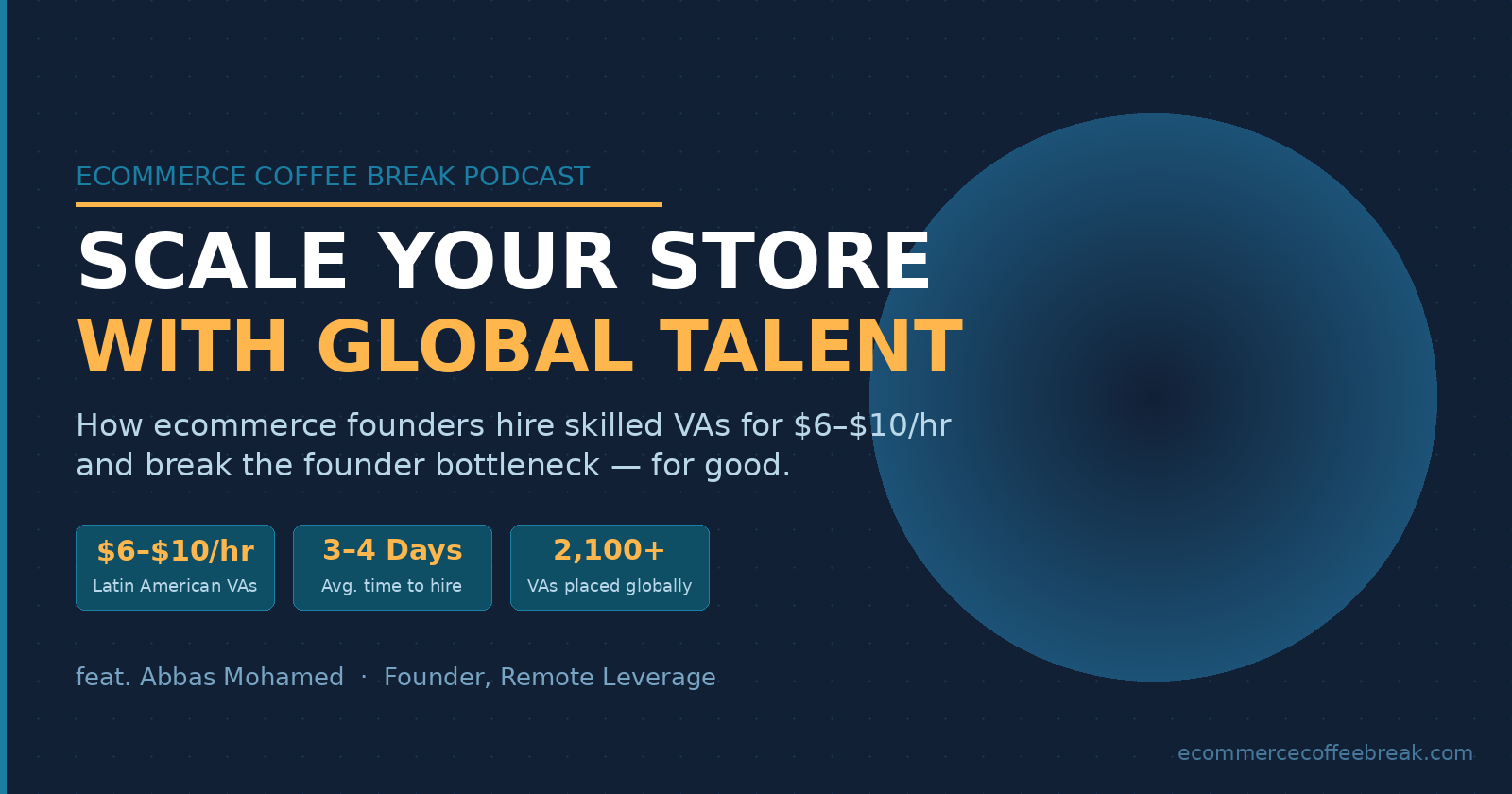
Hiring virtual assistants for ecommerce growth is one of the fastest ways to break the founder bottleneck — that invisible ceiling where you stop scaling because you are personally handling tasks someone else could do for $6–$10 per hour.
Companies like Remote Leverage place Latin American talent into ecommerce and DTC brands within as little as three days, covering roles from customer support and marketing to executive assistance and operations. The key is not whether you can afford to hire — it is identifying the right role to hand off first, then finding someone more skilled at that job than you.
Why Doing Everything Yourself Is Quietly Killing Your Ecommerce Store
Most ecommerce founders hit a wall not because of traffic or conversion rates, but because of time. Every hour spent answering customer emails, scheduling shipments, or running ad campaigns manually is an hour not spent on strategy, partnerships, or the next revenue milestone. Abbas Mohamed, founder of Remote Leverage and a three-time entrepreneur who scaled his first business to seven figures using virtual assistants, puts it plainly: if you are the best marketer, the best customer support rep, and the best operations manager in your business all at once, that is not a strength — it is a bottleneck.
Remote Leverage has now placed over 2,100 virtual assistants across hundreds of small businesses. The pattern Mohamed sees repeatedly is founders who believe they are the best person for every task — until they hire someone who proves otherwise. As he told the Ecommerce Coffee Break Podcast:
"I see people think they're the best until they find the right person. Then they realise they just didn't know what good looks like — and that's why they thought they were the best." — Abbas Mohamed, Founder, Remote Leverage
The math is brutal in its simplicity. If a founder is worth $200–$400 per hour in strategic output, spending 20 hours a week on $10-per-hour tasks costs the business thousands in lost opportunity every single week. The fix is not working harder. It is identifying which tasks are keeping you in the weeds and replacing yourself in those roles with skilled, affordable global talent.
The Right Way to Identify Your First (or Next) VA Hire
Before posting a job or browsing any talent platform, the single most important question is: what is the actual bottleneck? Not what you dislike doing. Not what feels easiest to hand off. What specific function, if removed from your plate today, would directly unlock revenue or growth?
Mohamed's team at Remote Leverage starts every client engagement with exactly this diagnostic. A consultant gets on a call with the business owner and maps the role before a single candidate is sourced. From that conversation, a hiring manager — someone who has conducted thousands of interviews — helps craft the job description, define responsibilities, set qualifications, and align expectations around company culture and values.
For most ecommerce brands with fewer than 50 employees, the first high-impact hire typically falls into one of these categories:
- Customer support — the single most time-consuming reactive task for growing stores, and one of the easiest to hand off with clear SOPs
- Executive assistant — inbox management, scheduling, supplier coordination, data entry, and any task that creates cognitive drag on the founder
- Marketing support — content scheduling, ad reporting, email list management, and creative asset coordination
- Operations and fulfilment admin — order processing, returns management, carrier communication, and inventory tracking
Remote Leverage reports that customer support, executive assistant, and marketing roles are typically filled within three to four days. More specialised or industry-specific roles — logistics, finance, technical — may take up to three or four weeks. Either way, the process is faster and significantly more vetted than posting on Upwork or Freelancer.com, where a single job listing can generate hundreds of unfiltered applications and still produce a poor hire.
Why Latin American VAs Are the Strategic Choice for US Ecommerce Brands
The global talent market for virtual assistants is large, but not all regions are equal for US-based ecommerce operators. While Remote Leverage also sources from South Africa, the Philippines, Egypt, and Europe, Mohamed is direct about why Latin America is his primary recommendation for DTC and ecommerce clients.
Three factors make the difference:
- Time zone alignment. Latin American VAs work in US time zones by default — no 12-hour lag, no overnight communication gaps, no handoff delays. For customer-facing or operations roles, this is non-negotiable.
- Language fluency. Candidates sourced through Remote Leverage speak English at a professional level. This matters enormously for customer support, sales, and marketing roles where written and spoken communication directly affects brand perception.
- Cost-to-skill ratio. Mohamed consistently cites a range of $6–$10 per hour for experienced Latin American talent. At that rate, a full-time hire (160 hours per month) costs between $960 and $1,600 monthly — a fraction of what a US-based equivalent would cost, with no employer tax burden, benefits overhead, or office cost.
Remote Leverage processes approximately 1,000 candidate applications per day and hosts 300–400 interviews daily. That candidate volume means the pre-vetting is done before any business owner sees a single name. By the time a client interviews, they are choosing from a curated shortlist — not sifting through a stack of automated applications.
How to Protect Brand Quality When You Hire Remotely
The most common objection to hiring virtual assistants for ecommerce growth is quality control. Founders worry that remote hires will not represent the brand correctly, miss the nuance of tone, or drift from standard operating procedures. These are legitimate concerns — but they are solvable with the right systems, not reasons to avoid hiring altogether.
Mohamed's framework for brand consistency with remote hires has three components:
- Interview for culture fit, not just skill. Remote Leverage allows clients to interview multiple candidates at no cost before making any payment. This pre-commitment window lets founders assess whether a candidate's communication style, attitude, and professionalism align with what the brand needs — before any financial commitment is made.
- Document your values explicitly. Mohamed recommends writing down company culture and behavioural expectations in concrete terms before onboarding anyone. Not vague values statements, but specific observable behaviours: how quickly should emails be responded to? What tone should customer messages take? What does "done" look like on a task? The clearer the brief, the faster a new hire can perform to standard.
- Use a replacement guarantee as your safety net. Remote Leverage offers a 12-month replacement guarantee on all placements. If a hire does not work out for any reason, the business gets a replacement search at no additional cost. This matters because even experienced hiring managers make wrong calls — having a structured safety net removes the fear that a single bad hire becomes an expensive dead end.
For ecommerce brands scaling rapidly — seasonal spikes, new market entries, fast headcount growth — Remote Leverage also assigns the same recruiters and hiring managers to repeat clients. That continuity means the third and fourth hire happens faster than the first, because the agency already knows the business's culture, workflow, and standards.
Key Takeaways
- Hiring virtual assistants for ecommerce growth works best when founders first identify the specific bottleneck role that is limiting revenue, not just the tasks they personally dislike.
- Latin American virtual assistants offer a strong combination of US time zone availability, English fluency, and affordable rates of $6–$10 per hour — making them a strategic fit for DTC and ecommerce brands targeting US customers.
- Remote Leverage operates on a one-time recruiting fee model: clients pay a single placement fee based on annual salary, then pay the VA directly — with no ongoing agency cut or monthly retainer.
- Common first VA hires for ecommerce stores include customer support, executive assistant, marketing coordination, and operations admin — roles that typically take three to four days to fill through Remote Leverage.
- Brand consistency with remote hires requires written culture documentation and explicit behavioural expectations, not micromanagement — the same standard that applies to any new hire, local or global.
- Remote Leverage offers a 12-month replacement guarantee and free pre-hire interviews, making the initial trial of virtual assistant hiring financially low-risk for small business owners.
This article is based on insights shared by Abbas Mohamed, founder of Remote Leverage, on the Ecommerce Coffee Break Podcast. Listen to the full conversation: How To Scale Your Ecommerce Business With Global Remote Talent
- Share: