

Optimize Product Data for Conversational Search in Ecommerce
How to Optimize Product Data for Conversational Search Before Your Competitors Do
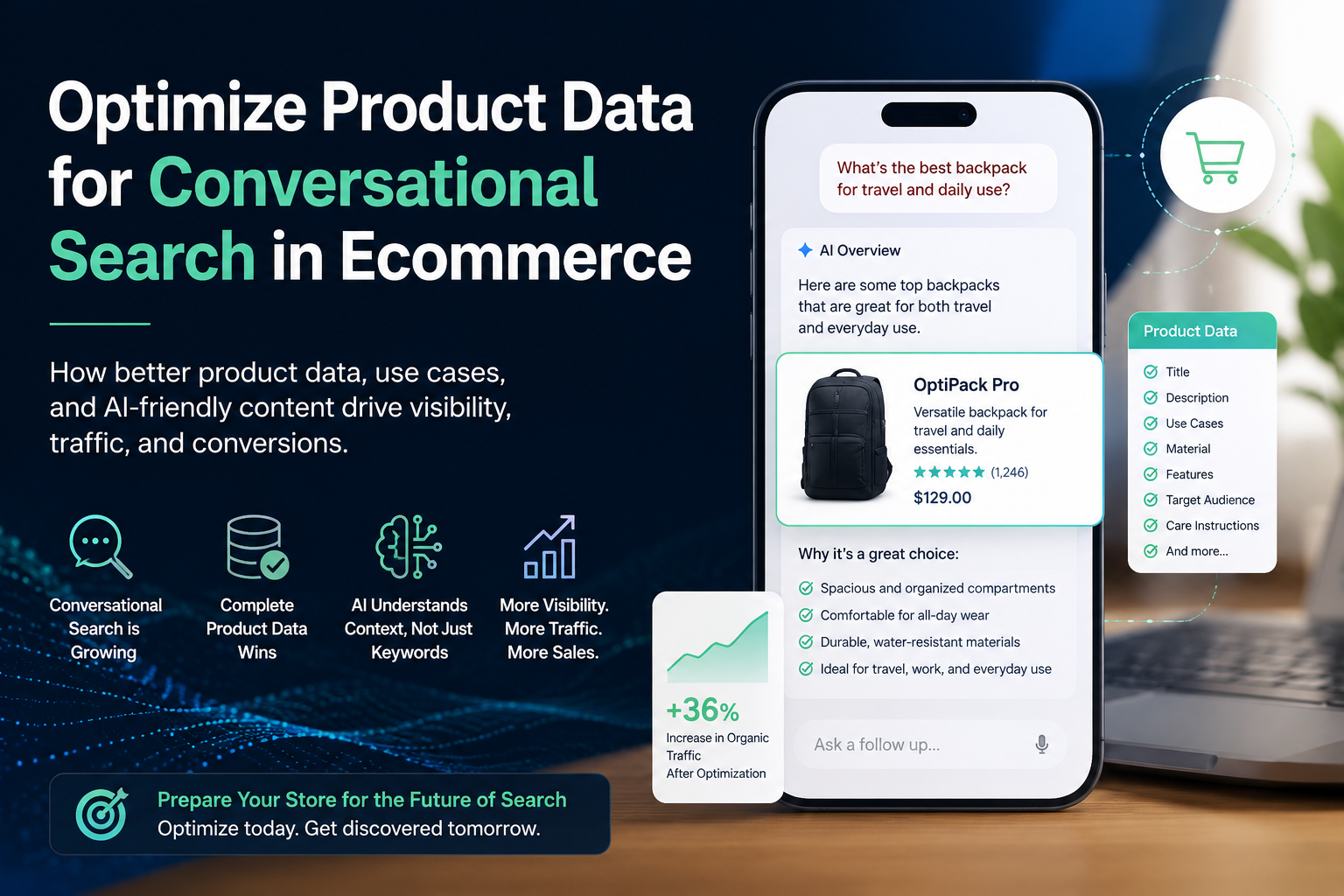
Ecommerce brands that want to stay visible in AI-powered search need to optimize product data for conversational search, not just traditional keywords. Search engines and AI assistants increasingly rely on structured product attributes, natural-language descriptions, and use-case context to match products with complex customer queries. Brands that provide richer product data are more likely to appear in Google AI Overviews, shopping results, and conversational commerce experiences.
For years, ecommerce SEO focused on ranking for short keywords. A shopper searched for “camping tent,” clicked a result, and compared products manually. Today, shoppers ask questions that sound more like conversations.
Instead of searching for a tent, a customer might ask: “What’s the best tent for a weekend camping trip in Texas with two young children during hot weather?”
That shift changes everything.
During a recent Ecommerce Coffee Break Podcast episode, Lucas Tieleman, Co-Founder of OptiVersal, explained why many ecommerce brands are becoming less visible as search evolves. The problem is not necessarily bad products or weak marketing. The problem is that many product catalogs were built for keyword search, while consumers are increasingly using conversational search powered by AI.
The brands that adapt fastest will gain visibility. The brands that ignore the shift may gradually lose traffic, clicks, and sales.
1. Fill More Product Attributes Than Your Competitors
One of the most practical insights from the discussion is surprisingly simple: most ecommerce brands leave valuable product data blank.
According to Tieleman, product feeds often support approximately 65 to 70 attributes per product. Yet many merchants only complete 10 to 15 attributes.
That creates a major opportunity.
When AI systems attempt to understand products, they rely heavily on available structured information. Missing attributes force search engines to guess. Complete attributes give AI systems confidence.
Many brands focus only on factual details such as:
- Color
- Size
- Material
- Weight
- Price
Those details remain important, but they are no longer enough.
To optimize product data for conversational search, brands should also include:
- Comfort level
- Use cases
- Ideal customer profiles
- Weather suitability
- Performance characteristics
- Lifestyle applications
- Problem-solving benefits
For example, a shirt should not only be described as “black cotton t-shirt.” It may also be comfortable for all-day wear, moisture-resistant, lightweight, suitable for travel, and ideal for outdoor activities.
These descriptive attributes align much better with how customers actually search today.
2. Stop Thinking About Keywords and Start Thinking About Customer Situations
Traditional SEO often focused on identifying keywords and placing them strategically throughout a page.
Conversational commerce requires a different mindset.
Customers increasingly describe situations instead of products.
Tieleman shared an example involving camping equipment. Rather than searching for “tent,” a shopper might describe:
- Where they are camping
- Who they are traveling with
- The expected weather
- Their budget
- Specific needs such as airflow or mosquito protection
AI systems can process these details and recommend products that best fit the scenario.
This means ecommerce brands should build content around customer situations.
Ask questions such as:
- What problem does this product solve?
- Who is it designed for?
- When should it be used?
- What alternatives are customers comparing?
- What environment is it best suited for?
The answers belong in product descriptions, product feeds, buying guides, category pages, FAQs, and supporting content.
Instead of optimizing for individual keywords, brands should optimize for complete buying journeys.
Lucas Tieleman emphasized that consumers now search using far more detailed natural language, and brands that provide structured context around product use cases make it easier for AI systems to connect the right products to the right shoppers.
3. Create AI-Friendly Landing Pages Around Search Intent
One of the most interesting strategies discussed was the creation of highly targeted landing pages based on actual search behavior.
OptiVersal identifies product-related search opportunities, validates search demand, and generates landing pages that address specific buying intents.
A practical example shared during the conversation involved a home goods retailer.
Instead of creating a generic cookware page, the company created a landing page focused on a specific question:
“What pans do chefs use?”
The page matched a real customer intent and attracted meaningful organic traffic.
According to Tieleman, AI-generated landing pages now drive approximately 16% of site traffic for some clients.
That highlights a major lesson for ecommerce marketers.
Many brands only create pages around products and categories. Yet customers often search using questions, comparisons, goals, or recommendations.
Consider creating content around:
- Best products for beginners
- Products professionals use
- Products for specific climates
- Products for specific age groups
- Products for particular hobbies
- Problem-solution content
Every landing page should help search engines understand relationships between customer needs and available products.
When implemented correctly, these pages become powerful acquisition assets that compound over time.
4. Watch for the Warning Signs That Search Visibility Is Slipping
Many merchants do not realize they are losing visibility until sales start declining.
Tieleman highlighted two practical signals that every ecommerce team should monitor.
Signal #1: Impressions Increase While Clicks Decline
If Google Search Console shows growing impressions but falling click-through rates, it may indicate that search behavior has evolved while your content has not.
Your products are still appearing occasionally, but they are no longer the most relevant answers for conversational queries.
Signal #2: Cost Per Click Continues Rising
If advertising costs increase while performance stagnates, you may be competing for a shrinking set of traditional keywords.
Meanwhile, competitors are expanding visibility across thousands of conversational search opportunities.
Tieleman noted that Google recently reported record query volumes, including growth in non-holiday periods.
The implication is important.
Search demand is not disappearing. Search behavior is expanding.
Brands that optimize product data for conversational search gain access to those emerging opportunities.
Brands that continue relying on legacy keyword strategies risk becoming less visible over time.
Key Takeaways
- Conversational search is changing how consumers discover products, with longer and more detailed search queries becoming common.
- Most ecommerce brands leave significant portions of their product feed attributes incomplete, limiting AI visibility.
- Use-case descriptions and customer context are increasingly important for product discovery.
- AI-friendly landing pages built around real customer questions can generate meaningful organic traffic growth.
- Rising cost-per-click and declining organic click-through rates can indicate lost visibility in conversational search.
- Brands that provide structured, complete, and helpful product data are more likely to be recommended by AI-powered search systems.
This article is based on insights shared by Lucas Tieleman, Co-Founder of Optiversal, on the Ecommerce Coffee Break Podcast. Listen to the full conversation: How Google’s Conversational Commerce Is Changing Everything