

How to Fix Shopify Revenue Leaks & Win at Agentic Commerce
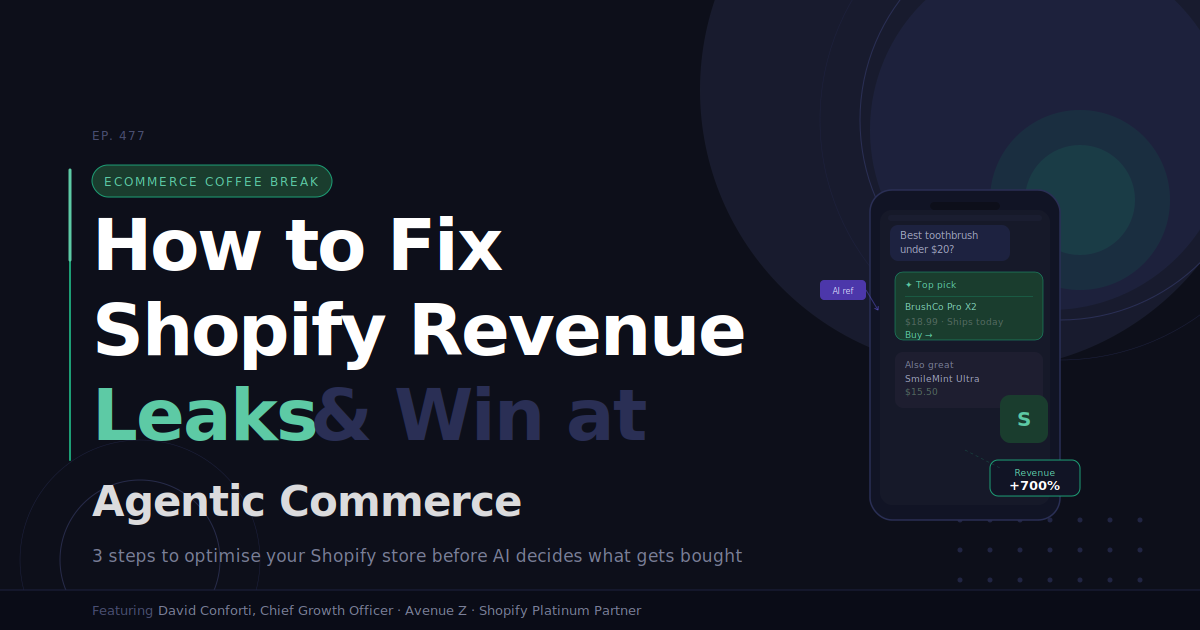
Shopify stores that are ready for agentic commerce — where AI tools like ChatGPT and Gemini surface and recommend products — need to optimise three core areas: their product catalog mapping, a well-structured knowledge base, and a consistent PR and SEO presence on trusted third-party sites. Most brands are already leaking revenue through outdated store infrastructure and neglected funnel touchpoints, and those gaps become far more costly as AI agents take over early-stage purchase decisions. Fixing these leaks now puts brands in the top tier of results that AI search returns — and being outside that top three is, effectively, being invisible.
Why Your Shopify Store Is Leaking Revenue (And You Don't Know It)
Most Shopify merchants don't have a traffic problem. They have a revenue leak problem — and the two are easy to confuse when ad spend keeps rising while growth stalls.
David Conforti, Chief Growth Officer at Avenue Z and former co-founder of conversion rate optimisation agency BarFi, has audited hundreds of Shopify stores. His diagnosis is consistent: brands that scale quickly outgrow their stores without realising it.
"The site you stand up on Shopify is oftentimes one of the templates you pull off the shelf," Conforti explains, "and then it just becomes legacy." As brands move from six figures to seven, then eight figures in annual revenue, the store that once worked fine quietly becomes an inhibitor of growth rather than a driver of it.
The fix isn't always dramatic. Conforti's team uses a framework they call the metric on fire — a systematic audit across every surface area of the business (paid acquisition, on-site experience, conversion rate, retention, and now agentic discovery) to identify exactly where revenue is bleeding out. Rather than guessing, they surface the single biggest lever and pull it first.
Here's what that audit consistently finds brands are missing:
- Product pages built for humans, not AI agents. Thin descriptions, missing variant data, and no structured FAQ content mean AI tools can't accurately surface or describe your products.
- No brand knowledge base in Shopify. Return policies, shipping timelines, and product use cases — the questions customers ask before buying — are buried in PDFs or missing entirely.
- Fulfilment notifications that are unbranded or generic. Post-purchase touchpoints are often overlooked, but they drive repeat purchase rates significantly.
- Siloed channel management. Brands running Meta, Google, TikTok, and their store through separate teams or agencies lose the cross-channel intelligence that reveals what's actually working.
How to Optimise Your Shopify Store for Agentic Commerce Right Now
Agentic commerce refers to two emerging realities: first, AI tools like ChatGPT, Gemini, and Grok are already surfacing product recommendations in response to shopping queries; second — and more disruptively — AI agents will soon make purchases autonomously on behalf of consumers based on pre-set parameters. Brands that aren't structurally ready will not appear at all.
Conforti, whose team works directly with Shopify's new product teams as one of just 36 Shopify Platinum Partners in the United States, breaks preparation into three non-negotiable pillars:
1. Product Catalog Mapping
Shopify's push into agentic commerce is built around catalog data. Every product needs complete variant mapping — size, colour, material, use case — so that when a customer asks ChatGPT to find "a lightweight running shoe under $120 in size 10," your product can be matched and surfaced accurately. Shopify brands have this infrastructure available out of the box, which is a significant competitive advantage over brands on other platforms.
2. A Structured Knowledge Base
Shopify's knowledge base feature allows brands to upload FAQ-style content that AI agents pull when answering customer questions. This includes return policies, shipping estimates, product comparisons, and specific use cases. If a customer's AI assistant is researching a product on their behalf and your brand's knowledge base is empty, you're handing the sale to a competitor who filled theirs in.
3. PR and SEO — More Important Than Ever
Here's the counterintuitive insight from Conforti that every brand needs to hear: traditional PR and SEO are experiencing a renaissance. ChatGPT doesn't return ten blue links — it returns one to three results, sourced from trusted publications like Forbes, Wirecutter, and Reddit. If your brand is not appearing in editorial lists and review roundups on these authoritative domains, you are functionally invisible to AI-driven discovery. A proactive PR strategy that places your products in "best of" and "top picks" content is now a direct revenue driver, not just a brand awareness exercise.
4. Ensure Your .com Experience Is Optimised for Referral Traffic
One of the most important recent shifts: ChatGPT is now treated as a referral source in Shopify analytics — customers research on AI platforms, then navigate to your store to purchase. Conforti's team sees this pattern clearly in client data. "We see a ton of halo effects where customers are actually going to your dot-com after researching on AI platforms." That means your homepage, collection pages, and product detail pages need to be ready to convert high-intent visitors who already know what they want.
TikTok's Surprising Role in Driving .com Revenue
Beyond agentic commerce, Conforti points to TikTok as the most underestimated driver of Shopify revenue right now — and the mechanism is not what most brands expect.
The assumption is that TikTok Shop captures the sale within the app, reducing the importance of the brand's own storefront. The data Avenue Z sees across their client portfolio tells a different story. "Whenever we push TikTok spend up, you immediately see a spike in .com homepage traffic and also revenue," Conforti notes. The customers converting on .com after TikTok exposure are high-intent buyers — they've already been warmed up by content and are arriving ready to purchase.
This insight reframes TikTok as a top-of-funnel content engine that feeds the broader ecosystem, rather than a standalone sales channel competing with your store. It also underscores the broader thesis: no single channel operates in isolation. The brands scaling fastest — like Kind Patches, which grew from approximately $1 million per month in revenue to $7–8 million per month in under nine months working with Avenue Z — are the ones treating acquisition, conversion, and retention as a single connected system, not separate workstreams.
For brands starting from zero today, Conforti's recommended sequence is clear: build on Shopify, grow aggressively on TikTok, repurpose that content for Meta ads, and ensure Google is fully optimised for high-intent purchase queries. Agentic commerce optimisation comes after that foundation is solid.
The Full-Funnel Imperative: Why Siloed Agencies Are Costing You Growth
One of the structural problems Conforti saw firsthand — and that ultimately led him to sell his CRO-focused agency BarFi to Avenue Z — is that single-channel partners can only see part of the picture.
"We felt like we were missing something by just doing the on-site experience," he explains. "We were missing so many insights and important parts of that flywheel." When the team running paid acquisition doesn't have visibility into on-site conversion data, and the CRO team doesn't know what TikTok content is driving traffic spikes, critical optimisation opportunities fall through the cracks.
Avenue Z's model — combining paid media, CRO, and retention under one roof — is designed specifically to capture those cross-channel signals. Their onboarding process takes two to four weeks and begins with a comprehensive audit of every surface area: paid channels, on-site experience, fulfilment notifications, the Shop app, and now agentic readiness.
The metric on fire framework, coined by Alex Zamora (previously Director of E-Commerce Marketing and Retention at True Classic, a DTC brand doing nine figures in revenue), keeps the team focused: at any given moment, one metric is the highest-priority problem. Fix that first, then move to the next. It's a deceptively simple idea that keeps growing brands from spreading their optimisation efforts too thin.
"Brands that are very successful are very lean and nimble teams — sometimes just a headcount of ten people doing nine figures in revenue — and they're leaning on a suite of partners. The brands that struggle are the ones managing too many separate relationships without a single partner that has the full picture."
Key Takeaways
- Shopify stores that scale quickly often outgrow their original site infrastructure, creating silent revenue leaks in conversion, retention, and discovery that compound over time.
- Agentic commerce readiness requires three core elements: complete product catalog mapping in Shopify, a populated knowledge base with FAQs and policies, and active PR and SEO placement on trusted third-party publications.
- ChatGPT currently surfaces one to three product results — not ten — meaning brands outside the top results are functionally invisible to AI-driven shopping queries.
- TikTok spend consistently drives measurable spikes in .com homepage traffic and direct revenue, functioning as a top-of-funnel content engine rather than just an in-app sales channel.
- Shopify's native infrastructure — catalog mapping, knowledge base, and UCP integration with Google — gives Shopify merchants a structural head start in the agentic commerce transition that brands on other platforms do not have.
- A full-funnel partner with visibility across acquisition, conversion, and retention consistently outperforms siloed single-channel agencies because cross-channel data reveals optimisation opportunities that isolated teams miss entirely.
This article is based on insights shared by David Conforti on the Ecommerce Coffee Break Podcast. Listen to the full conversation: How To Fix Revenue Leaks And Win At Agentic Commerce With David Conforti