

How to Turn Ecommerce Returns Into a Revenue Recovery Channel
How to Turn Ecommerce Returns Into a Revenue Recovery Channel
Most ecommerce brands treat returns as an unavoidable tax on their business — they bake a 10% return rate into their cost of goods, write off the loss, and move on. But according to JD Sassi, founder and CEO of Axiom Return Solutions, that mindset is leaving significant money on the table. Brands that build a returns revenue recovery strategy can recoup a meaningful portion of "lost" inventory, collect SKU-level data that reduces future returns, and even file reimbursement claims against fraudulent or incomplete returns — all from inventory they would have sent to the landfill.
Why Your Current Returns Strategy Is Costing You More Than You Think
The standard approach to ecommerce returns involves one of two outcomes: Amazon disposes of the item, or a 3PL receives a pallet and sends you a box every few months. Neither approach generates meaningful data or revenue recovery. Here's where the hidden losses actually occur:
- Disposal by default. When Amazon disposes of inventory on your behalf, their terms explicitly state they may recycle, dispose of, or resell the item — and keep any proceeds. Brands that choose removal instead of disposal can offset those same costs while retaining the inventory and its recovery potential.
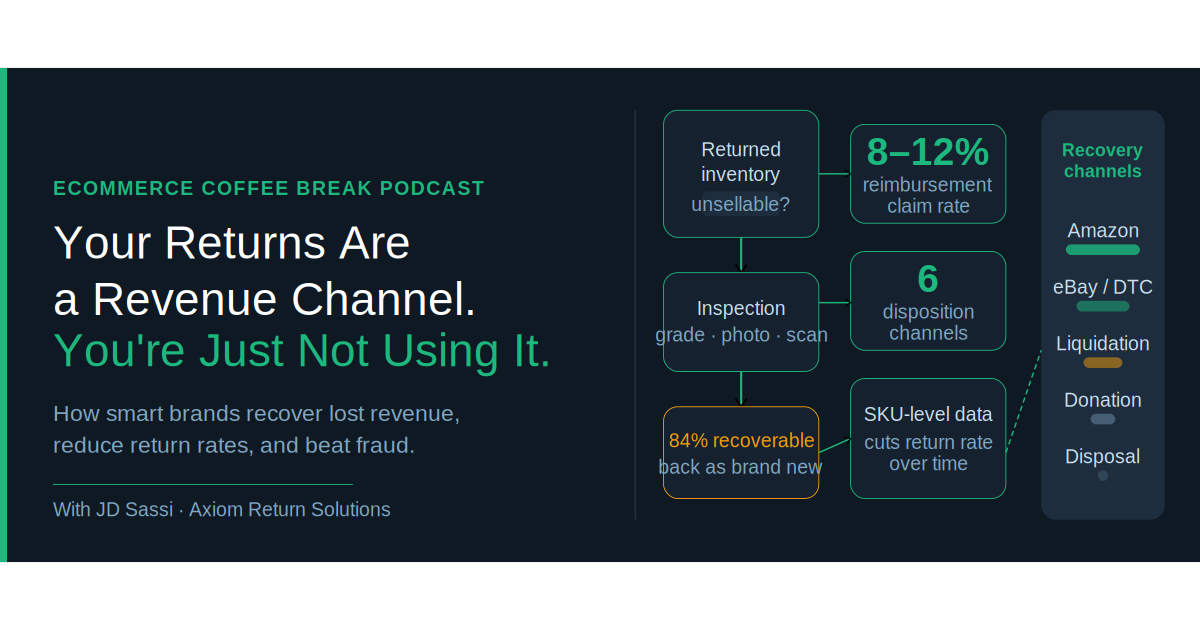
- Missed reimbursement claims. Sassi's team finds that between 8% and 12% of returned units qualify for a reimbursement claim — covering fraudulent returns, missing items, shorted shipments, or items returned with missing components. Most brands never file these claims because they lack the documentation process to support them.
- Unsellable inventory that isn't actually unsellable. Amazon labels inventory "unsellable" based on surface-level inspection. In a pilot with a Halloween costume company, Axiom found that nearly 84% of units labeled unsellable could be reintegrated as brand new, with about 60% going straight back into Amazon after repackaging or a new insert. That's an enormous recovery rate on inventory that was assumed to be worthless.
- Zero insight into why returns are happening. Without a granular inspection process, brands have no SKU-level data on return reasons, defect patterns, or fulfillment errors. That makes it impossible to reduce returns at the source.
Build a Returns Revenue Recovery Strategy in 4 Steps
Turning your returns channel into a recovery operation doesn't require an overhaul of your entire fulfillment stack. The process is more straightforward than most brands expect.
- Change your return and removal address. The first mechanical step is routing returned inventory to a specialist returns facility rather than a general 3PL or back to your own warehouse. This single change gives a dedicated team the ability to inspect, grade, and disposition every unit systematically, rather than letting pallets sit in storage for months.
- Define your disposition tiers before inventory arrives. Work with your returns partner to establish a clear scope of work for each SKU and grade. If a unit arrives brand new in sealed packaging, it should go straight back to your primary sales channel — typically Amazon. If it's opened but functional, what's the next channel: your own DTC site at a discount, eBay, Facebook Marketplace, or a liquidation buyer? Having this agreed upon in advance keeps operations lean and avoids decision paralysis when volume spikes.
- Document everything for reimbursement claims. Filing claims with Amazon Seller Central requires photographic evidence — pictures of the product, the packing slip, serial numbers (especially for electronics and tools), and any visible tampering. If a returned item's serial number doesn't match the box, that's a fraudulent return eligible for reimbursement. If a multi-piece product comes back missing a component, that's also claimable. Without a systematic photo documentation process on inbound, none of these claims are possible.
- Use SKU-level return data to reduce future returns. Over time, patterns become clear. Some SKUs come back 100% sellable every time. Others come back with a consistent defect — packaging that fails in transit, a production error that generates returns from confused customers, or listing images that don't match the actual product. Sassi describes this as "removing emotion from the equation" — decisions about production changes, packaging improvements, and listing updates become data-driven rather than reactive.
Stop Fraudulent Returns Before They Happen — And Recover Revenue When They Do
Return fraud is more common — and more creative — than most brands acknowledge. The classic example in the Amazon ecosystem is a customer purchasing a high-value item like a pair of Nike shoes or an electronics product, swapping it with a worthless substitute, and returning the box with the tamper-proof seal still intact on the top. Amazon scans the seal, sees it's unbroken, classifies the item as new, and relists it. The next customer gets a used or counterfeit product. The bad review lands on the brand. One packaging fix Sassi recommends is low-cost but highly effective: apply tamper-proof seals on every opening of a product's box, not just the top. If a customer can open the bottom without breaking a seal, that's the vulnerability fraudsters exploit. Closing that gap means Amazon's inbound inspection correctly flags opened items, and the inventory routes to the appropriate disposition tier rather than back onto the shelf as new. For electronics and tools, serial number matching is another layer of protection. When the serial on the product doesn't match the serial on the box, that discrepancy is documentable and claimable. The key is having staff trained to look for it and a system to photograph and upload evidence to Seller Central promptly.
"If you buy a bad pair of Nike shoes, it doesn't matter who you bought them from — the bad review goes to the brand. There's a lot happening on the back end that has just been overlooked for a long time." — JD Sassi, Founder & CEO, Axiom Return Solutions
Choosing the Right Secondary Channels for Recovered Inventory
Not every returned item can go back to your primary channel, and that's fine. The goal of a returns revenue recovery strategy is to maximize value across a tiered disposition structure, not to force everything back into Amazon. Sassi identifies roughly six disposition routes, listed here in rough order of recovery value:
- Primary channel reintegration (Amazon, your DTC site) — highest revenue recovery, reserved for items that meet new or like-new standards after inspection and any necessary repackaging.
- Discounted DTC offering — selling lightly used or open-box items directly on your own website at a markdown. This keeps the transaction with your brand and can convert a return into a repeat customer relationship.
- Peer-to-peer and social commerce — eBay remains the dominant secondary marketplace for most categories. Facebook Marketplace, TikTok Shop, and live-streaming liquidation channels (where warehouse staff sell items on stream) are growing options for brands comfortable with those platforms.
- Traditional liquidation — palletizing inventory and selling in bulk to liquidation buyers. Lower per-unit recovery, but fast and volume-friendly.
- Donation — depending on your business structure, donated inventory may offer a tax advantage. It also keeps product out of the landfill, which matters for brands with sustainability commitments.
- Manifested disposal — for inventory that genuinely cannot be resold (expired products, beauty items with compromised packaging, or anything that has been used in a way that creates liability), documented destruction protects brand integrity. Sassi's team provides serialized disposal records so brands can verify that inventory didn't end up on an unauthorized resale channel.
Key Takeaways
- Ecommerce brands that write off all returned inventory as a loss are missing recoverable revenue — a structured returns process can reintegrate a significant portion of "unsellable" units back into primary sales channels.
- Between 8% and 12% of returned Amazon inventory typically qualifies for a reimbursement claim covering fraudulent returns, missing units, shorted shipments, or incomplete multi-piece items.
- In a documented case study with a Halloween costume brand, Axiom Return Solutions found that 84% of Amazon-labeled unsellable units could be reintegrated as brand new after inspection and repackaging.
- Applying tamper-proof seals to every opening on a product's packaging — not just the top — is a low-cost way to prevent return fraud and ensure accurate condition classification at Amazon's fulfillment centers.
- SKU-level return data collected during inspection reveals patterns in defects, packaging failures, and listing inaccuracies that, when addressed, reduce the return rate itself over time.
- A tiered disposition strategy — from primary channel reintegration through eBay, DTC discount, liquidation, donation, and manifested disposal — maximises recovery value across different inventory conditions.
This article is based on insights shared by JD Sass, Founder and CEO of Axiom Return Solutions, on the Ecommerce Coffee Break Podcast. Listen to the full conversation: How Smart Brands Turn Returns Into a Revenue Recovery Channel
- Share: