Partner With Us. Reach 70K Ecom Operators. Learn more Ecommerce Coffee Break Podcast and Newsletter

Ecommerce Coffee Break Ecommerce Coffee Break
  • HOME
  • PODCAST
    • Browse All Episodes
    • Playlists By Topic
    • Be a Podcast Guest
    • Suggest a Guest
  • NEWSLETTER
    • Subscribe
    • Past Issues
    • Advertise
  • PARTNERS
  • PARTNER WITH US
    • Be a Podcast Guest
    • Advertise/Sponsor
  • REVIEWS
    • Reviews
    • Rate on Apple Podcasts
    • Rate on Spotify
  • SUBSCRIBE
    • Email Newsletter
    • Apple Podcasts
    • Spotify
    • YouTube
    • iHeart
    • Amazon Music
    • Overcast
    • Castbox
    • Podurama
    • RSS Feed
  • ABOUT US
  • HOME
  • PODCAST
    • Browse All Episodes
    • Playlists By Topic
    • Be a Podcast Guest
    • Suggest a Guest
  • NEWSLETTER
    • Subscribe
    • Past Issues
    • Advertise
  • PARTNERS
  • PARTNER WITH US
    • Be a Podcast Guest
    • Advertise/Sponsor
  • REVIEWS
    • Reviews
    • Rate on Apple Podcasts
    • Rate on Spotify
  • SUBSCRIBE
    • Email Newsletter
    • Apple Podcasts
    • Spotify
    • YouTube
    • iHeart
    • Amazon Music
    • Overcast
    • Castbox
    • Podurama
    • RSS Feed
  • ABOUT US
  • Home
  • Content Hub
  • Headless Commerce Migration Strategy: 4 Steps to Success

Content Hub

23 Apr

Headless Commerce Migration Strategy: 4 Steps to Success
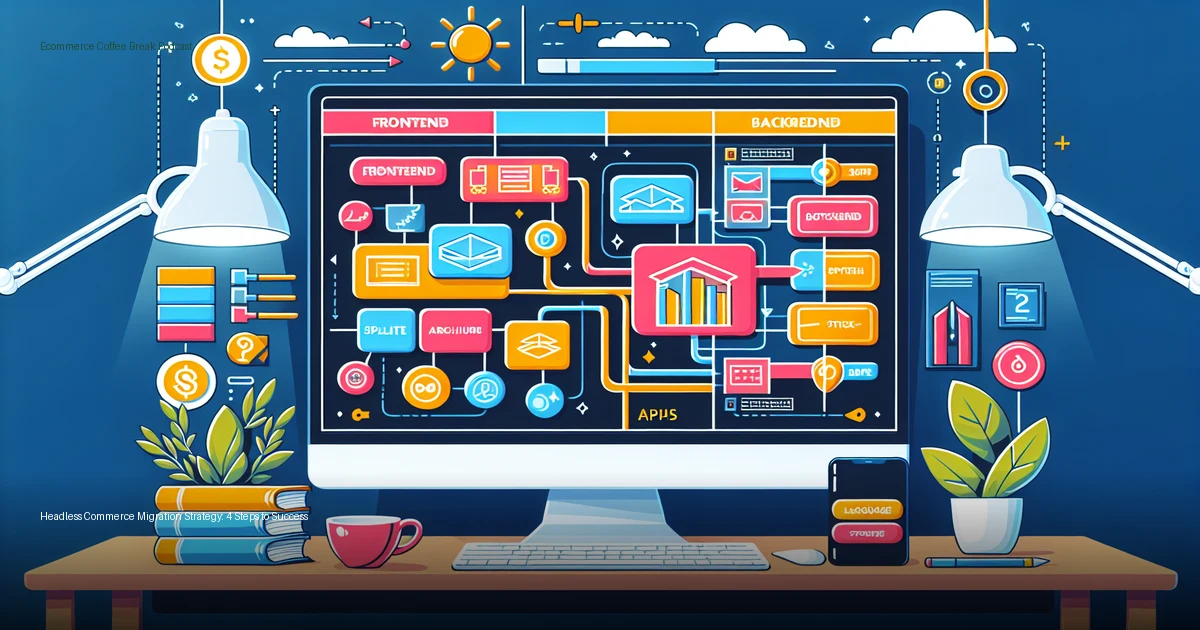
A successful headless commerce migration typically takes six months and involves four critical phases: design strategy overhaul, content management system selection, backend integration, and performance optimization. This approach can deliver significant results, with some stores seeing conversion rate increases of 7% from just 0.2 seconds of performance improvement.

Phase 1: Strategic Design Overhaul and Requirements Assessment

The foundation of any headless commerce migration begins with reimagining your customer experience beyond the constraints of traditional themes. Unlike conventional platforms where you’re limited to predefined templates, headless architecture provides complete design freedom that should be leveraged strategically.

Start by conducting a comprehensive audit of your current store’s limitations. Most merchants using traditional platforms rely on themes that come with built-in constraints affecting everything from page layouts to mobile responsiveness. When planning your headless commerce migration, resist the temptation to simply replicate your existing design in a new framework.

Key considerations during this phase include:

  • Identifying customer journey friction points in your current setup
  • Documenting complex product variants and customization needs
  • Analyzing traffic patterns and device usage across your customer base
  • Evaluating which design elements truly drive conversions versus those that create unnecessary complexity

For stores with high traffic volumes or complex product catalogs, this phase becomes even more critical. As Synim Selimi from Sogody explains, “Store owners who have customers which require very unique experiences, and stores which are very complex in terms of products and variants, would probably benefit a lot from going headless.”

Phase 2: Content Management System Selection and Schema Design

The choice of content management system can make or break your headless commerce migration success. Unlike traditional platforms where content management is built-in, headless architecture requires you to select and configure a separate CMS that will power your content delivery.

Sanity.io has emerged as the leading choice for headless commerce implementations, offering granular control over content schemas and publishing workflows. The key advantage lies in its ability to create reusable component libraries that can be deployed across multiple channels and devices simultaneously.

During CMS selection and setup, focus on:

  • Defining what elements should be configurable (button colors, item orders, mobile vs desktop visibility)
  • Creating content schemas that support your specific product types and variants
  • Building component libraries that can scale with your business growth
  • Establishing publishing workflows that don’t require technical expertise for daily operations

The investment in proper CMS architecture pays dividends in operational efficiency. Well-structured component libraries enable rapid deployment of new landing pages and marketing funnels without additional development resources.

Phase 3: Backend Integration and App Compatibility Assessment

One of the most complex aspects of headless commerce migration involves maintaining functionality from your existing tech stack while gaining the performance benefits of decoupled architecture. This phase requires careful evaluation of your current app ecosystem and integration requirements.

For Shopify merchants, Shopify Plus membership significantly streamlines this process by providing enhanced API access and integration capabilities. However, headless commerce migration is possible on standard Shopify plans with appropriate workarounds, though the timeline may extend beyond the typical six-month implementation period.

Critical integration considerations include:

  • Auditing existing Shopify apps for headless API support
  • Identifying mission-critical functionalities that require custom integration work
  • Planning data migration strategies that minimize downtime
  • Testing payment processing, inventory management, and fulfillment workflows

While some legacy apps may require additional development work for headless compatibility, most modern Shopify applications offer API support that enables seamless integration. The key is identifying these requirements early in the planning process to avoid surprises during implementation.

“Usually it takes at least six months to do a complete migration to headless. Bigger clients have more requirements, smaller store owners can expect this migration even earlier. However, to feel satisfied in terms of quality and in terms of deliverables, usually six months is a good timeline.” – Synim Selimi, Sogody

Phase 4: Performance Optimization and Conversion Testing

The ultimate goal of headless commerce migration is measurable improvement in site performance and conversion rates. This phase involves rigorous testing and optimization to ensure your investment delivers tangible business results.

Performance improvements in headless architecture come from several technical advantages: faster loading times through optimized code delivery, better mobile responsiveness through device-specific optimization, and improved scalability through cloud-based hosting solutions like Netlify or Vercel.

However, performance gains alone don’t guarantee conversion improvements. The real value emerges from the enhanced user experience enabled by superior site speed and design flexibility. One Sogody client experienced a 7% conversion rate increase from just a 0.2-second performance improvement, demonstrating the direct correlation between technical optimization and business outcomes.

Essential testing and optimization activities include:

  • A/B testing site speed improvements against conversion rate changes
  • Mobile performance optimization across different devices and connection speeds
  • User journey analysis to identify remaining friction points
  • Continuous monitoring of Core Web Vitals and their impact on search rankings

The testing phase should also validate that your headless commerce migration delivers the flexibility benefits promised. Your team should be able to rapidly deploy new page layouts, test different user experiences, and iterate on design elements without requiring developer resources for every change.

Key Takeaways

  • Headless commerce migration typically requires six months for complete implementation, with design strategy being the most critical first phase.
  • Content management system selection, particularly tools like Sanity.io, determines long-term operational efficiency and scalability.
  • Shopify Plus membership significantly simplifies backend integration, though standard Shopify plans can work with additional development effort.
  • Performance improvements from headless architecture can deliver measurable conversion rate increases, with some implementations seeing 7% improvements from minor speed gains.
  • The investment is most suitable for high-traffic stores with complex product catalogs or unique customer experience requirements.
  • Proper component library architecture enables rapid deployment of new features without ongoing development costs.
How long does a headless commerce migration typically take?
A complete headless commerce migration usually takes at least six months for quality implementation. Larger stores with more complex requirements may need additional time, while smaller merchants might complete the process faster.
 
Can I migrate to headless commerce without Shopify Plus?
Yes, headless migration is possible on standard Shopify plans, though Shopify Plus makes the process significantly easier with enhanced API access. Standard plans require additional workarounds that may extend the implementation timeline.
 
What happens to my existing Shopify apps during headless migration?
Most modern Shopify apps offer API support for headless integration, though some legacy applications may require custom development work. The key is auditing your app ecosystem early to identify compatibility requirements and potential workarounds.
 
This article is based on insights shared by Synim Selimi and Shkumbin Maxhuni on the Ecommerce Coffee Break Podcast. Listen to the full conversation: Headless eCommerce vs Traditional eCommerce | Ecommerce Coffee Breakfast Podcast
Tags:conversion optimizationecommerce migrationheadless commerceShopify Plussite performance
  • Share:
Ecommerce Coffee Break Podcast

Search Site

LISTEN ON

Apple Podcast itunes Spotify

YouTube Logo Overcast Logo

Castbox Logo Podurama Logo

iHeart Radio Subscribe by Email

Latest Episode

How to Build Customer Loyalty Through Product Innovation — Nathan Yun | How Product Innovation Drives Loyalty, What Paire Learned From Buyer Feedback, Why Brands Focus on Customer Retention, How Fabric Tech Solves Apparel Issues (#506)
12Oct,2026

SUPPORT OUR PARTNERS

XERO
Bizrate Insights
Free Ecommerce Guides

Rankings & Awards

FeedSpot Logo
Global-Podcast-Rank

Who should we interview next? Who would make a great guest? Let us know.

Suggest a Guest

The Ecommerce Coffee Break — The B2B Media Platform Built to Connect the Ecommerce Industry. Discover the sales and marketing strategies top ecommerce brands actually use to grow revenue faster.

Get the Free Newsletter for Ecommerce Operators
  • Home
  • About
  • Episodes
  • Partner with Us
  • Newsletter
  • Rankings & Awards
  • Media Kit
  • Community
  • Guest Application
  • Content Hub
  • Contact
  • Free Resources

LISTEN ON

  • Apple Podcasts
  • Spotify
  • Amazon Music
  • YouTube Music
  • Castbox
  • RSS Feed
  • iHeart Radio

Follow on Social

LinkedIn Claus Lauter Facebook Claus Lauter Twitter Claus Lauter Instagram Claus Lauter YouTube Claus Lauter

☕ 100% powered by caffeine and curiosity. Disclaimer: The Ecommerce Coffee Break is independent media not affiliated with or endorsed by Amazon™, Shopify™, or any third party.

© 2019–2026 idube Pte Ltd. All Rights Reserved.

  • Home
  • Privacy
  • Terms
  • Disclaimer
  • Cookie Policy
  • Imprint
  • Sitemap
Manage Consent
To provide the best experiences, we use technologies like cookies to store and/or access device information. Consenting to these technologies will allow us to process data such as browsing behavior or unique IDs on this site. Not consenting or withdrawing consent, may adversely affect certain features and functions.
Functional Always active
The technical storage or access is strictly necessary for the legitimate purpose of enabling the use of a specific service explicitly requested by the subscriber or user, or for the sole purpose of carrying out the transmission of a communication over an electronic communications network.
Preferences
The technical storage or access is necessary for the legitimate purpose of storing preferences that are not requested by the subscriber or user.
Statistics
The technical storage or access that is used exclusively for statistical purposes. The technical storage or access that is used exclusively for anonymous statistical purposes. Without a subpoena, voluntary compliance on the part of your Internet Service Provider, or additional records from a third party, information stored or retrieved for this purpose alone cannot usually be used to identify you.
Marketing
The technical storage or access is required to create user profiles to send advertising, or to track the user on a website or across several websites for similar marketing purposes.
  • Manage options
  • Manage services
  • Manage {vendor_count} vendors
  • Read more about these purposes
View preferences
  • {title}
  • {title}
  • {title}
Manage Consent
To provide the best experiences, we use technologies like cookies to store and/or access device information. Consenting to these technologies will allow us to process data such as browsing behavior or unique IDs on this site. Not consenting or withdrawing consent, may adversely affect certain features and functions.
Functional Always active
The technical storage or access is strictly necessary for the legitimate purpose of enabling the use of a specific service explicitly requested by the subscriber or user, or for the sole purpose of carrying out the transmission of a communication over an electronic communications network.
Preferences
The technical storage or access is necessary for the legitimate purpose of storing preferences that are not requested by the subscriber or user.
Statistics
The technical storage or access that is used exclusively for statistical purposes. The technical storage or access that is used exclusively for anonymous statistical purposes. Without a subpoena, voluntary compliance on the part of your Internet Service Provider, or additional records from a third party, information stored or retrieved for this purpose alone cannot usually be used to identify you.
Marketing
The technical storage or access is required to create user profiles to send advertising, or to track the user on a website or across several websites for similar marketing purposes.
  • Manage options
  • Manage services
  • Manage {vendor_count} vendors
  • Read more about these purposes
View preferences
  • {title}
  • {title}
  • {title}

Become a smarter online seller in 3 minutes

Free weekly newsletter read by 15,000+ Shopify merchants, Amazon sellers, and DTC brands.

Join 100% free • Twice a week • Unsubscribe anytime