Partner With Us. Reach 70K Ecom Operators. Learn more Ecommerce Coffee Break Podcast and Newsletter

Ecommerce Coffee Break Ecommerce Coffee Break
  • HOME
  • PODCAST
    • Browse All Episodes
    • Playlists By Topic
    • Be a Podcast Guest
    • Suggest a Guest
  • NEWSLETTER
    • Subscribe
    • Past Issues
    • Advertise
  • PARTNERS
  • PARTNER WITH US
    • Be a Podcast Guest
    • Advertise/Sponsor
  • REVIEWS
    • Reviews
    • Rate on Apple Podcasts
    • Rate on Spotify
  • SUBSCRIBE
    • Email Newsletter
    • Apple Podcasts
    • Spotify
    • YouTube
    • iHeart
    • Amazon Music
    • Overcast
    • Castbox
    • Podurama
    • RSS Feed
  • ABOUT US
  • HOME
  • PODCAST
    • Browse All Episodes
    • Playlists By Topic
    • Be a Podcast Guest
    • Suggest a Guest
  • NEWSLETTER
    • Subscribe
    • Past Issues
    • Advertise
  • PARTNERS
  • PARTNER WITH US
    • Be a Podcast Guest
    • Advertise/Sponsor
  • REVIEWS
    • Reviews
    • Rate on Apple Podcasts
    • Rate on Spotify
  • SUBSCRIBE
    • Email Newsletter
    • Apple Podcasts
    • Spotify
    • YouTube
    • iHeart
    • Amazon Music
    • Overcast
    • Castbox
    • Podurama
    • RSS Feed
  • ABOUT US
  • Home
  • Content Hub
  • Retail stock accuracy Shopify: Fix inventory errors fast

Content Hub

13 Apr

Retail stock accuracy Shopify: Fix inventory errors fast
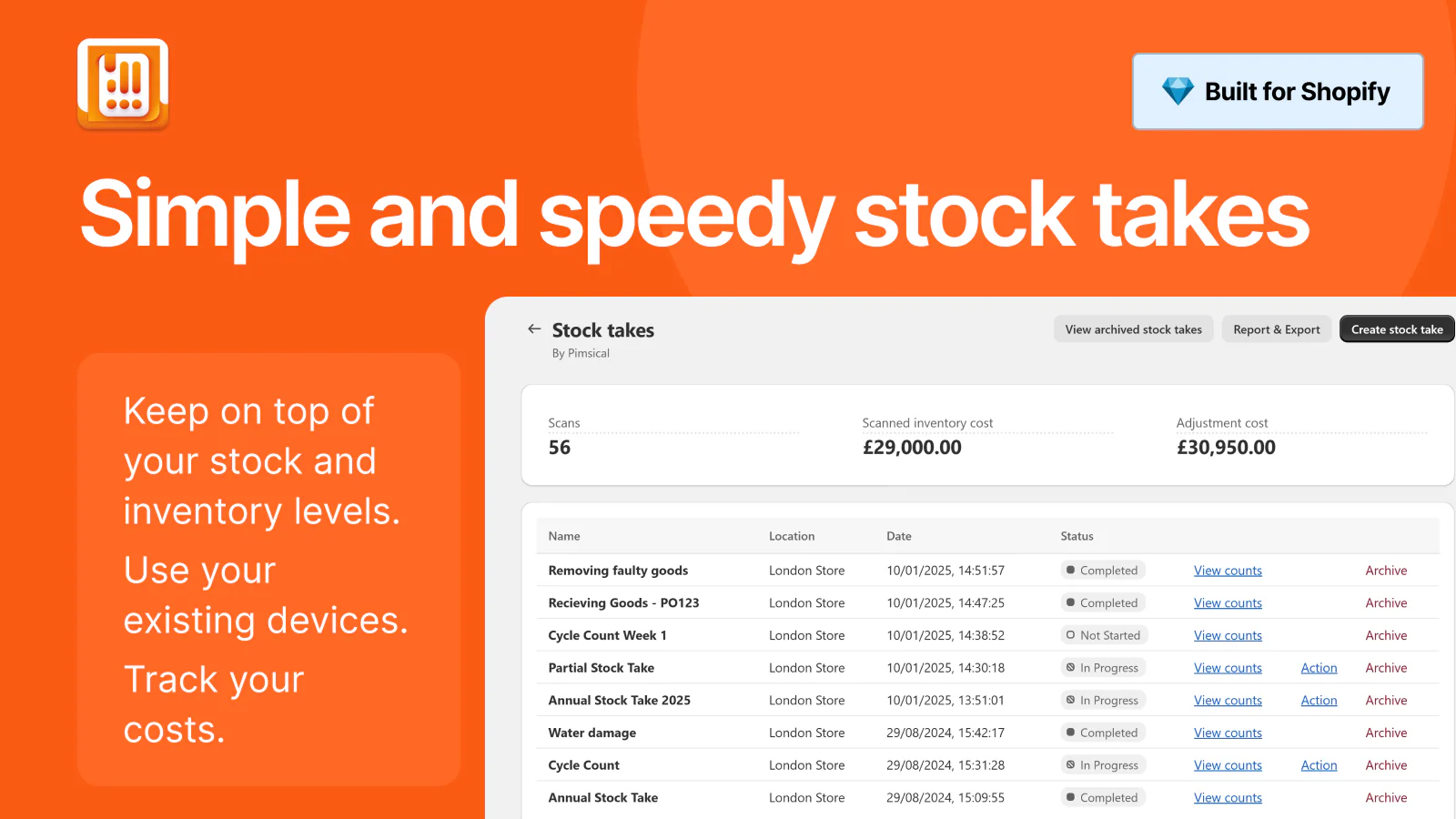
PML Stock Take Inventory Count

Most Shopify retailers don’t have an inventory problem—they have an accuracy problem. If your numbers are off, everything breaks: sales, customer experience, and team efficiency. This guide shows how to improve retail stock accuracy Shopify stores depend on, using simple workflows, better habits, and the right tools.

The fastest way to improve retail stock accuracy Shopify merchants rely on is to combine frequent stock checks, barcode-based workflows, and Shopify-native tools that your team already understands. When inventory is accurate, you prevent lost sales, reduce wasted time, and create a smoother in-store experience.

1. Fix the Real Problem: Inventory Errors Start with Broken Processes

Inventory issues rarely come from one big mistake. They come from small, repeated breakdowns in process.

In the interview, Jordan Finneran points out that inventory is often seen as “boring” and overlooked. Teams focus on marketing, conversion rates, and growth—while inventory quietly drifts out of sync.

That creates a dangerous illusion: everything looks fine… until it’s not.

  • Stock levels don’t match across systems
  • Staff rely on memory or guesswork
  • Stock rooms become disorganized
  • Products exist in the system but not on shelves

The goal is consistency, not perfection.

2. Replace Annual Stock Takes with Continuous Counting

If you’re still doing one big stock take per year, you’re already behind.

Jordan explains that investigating a stock issue from last week is manageable—but trying to trace something from 11 months ago is almost impossible.

  • Run weekly partial inventory checks
  • Focus daily on high-value or fast-moving SKUs
  • Split stock takes across teams

Jordan Finneran emphasizes that inventory issues are far easier to fix when caught early, making regular stock checks far more effective than large, infrequent audits.

3. Use Barcode Scanning to Remove Guesswork

Manual counting introduces mistakes at every step. Barcode scanning removes that.

  • Use smartphones as scanners via Shopify POS
  • Allow multiple team members to scan
  • Standardize workflows

One merchant counted over 55,000 units using this method.

4. Avoid ERP Overkill—Stay Lean with Shopify-Native Tools

ERP systems add complexity. Shopify-native tools keep things simple.

  • No extra systems
  • Faster onboarding
  • Less training needed

5. Act Now: The Stocky Shutdown Changes Everything

Stocky is being phased out. Merchants need to prepare now.

  • Audit current processes
  • Test new tools early
  • Train teams

Key Takeaways

  • Inventory accuracy impacts revenue and customer experience.
  • Frequent checks beat annual stock takes.
  • Barcode scanning reduces errors.
  • Shopify-native tools outperform complex ERP setups.
  • Stocky removal requires action.

This article is based on insights shared by Jordan Finneran on the Ecommerce Coffee Break Podcast.

Tags:Inventory Managementretail operationsshopify inventoryShopify POSstock accuracy
  • Share:
Ecommerce Coffee Break Podcast

Search Site

LISTEN ON

Apple Podcast itunes Spotify

YouTube Logo Overcast Logo

Castbox Logo Podurama Logo

iHeart Radio Subscribe by Email

Latest Episode

How to Build Customer Loyalty Through Product Innovation — Nathan Yun | How Product Innovation Drives Loyalty, What Paire Learned From Buyer Feedback, Why Brands Focus on Customer Retention, How Fabric Tech Solves Apparel Issues (#506)
12Oct,2026

SUPPORT OUR PARTNERS

XERO
Bizrate Insights
Free Ecommerce Guides

Rankings & Awards

FeedSpot Logo
Global-Podcast-Rank

Who should we interview next? Who would make a great guest? Let us know.

Suggest a Guest

The Ecommerce Coffee Break — The B2B Media Platform Built to Connect the Ecommerce Industry. Discover the sales and marketing strategies top ecommerce brands actually use to grow revenue faster.

Get the Free Newsletter for Ecommerce Operators
  • Home
  • About
  • Episodes
  • Partner with Us
  • Newsletter
  • Rankings & Awards
  • Media Kit
  • Community
  • Guest Application
  • Content Hub
  • Contact
  • Free Resources

LISTEN ON

  • Apple Podcasts
  • Spotify
  • Amazon Music
  • YouTube Music
  • Castbox
  • RSS Feed
  • iHeart Radio

Follow on Social

LinkedIn Claus Lauter Facebook Claus Lauter Twitter Claus Lauter Instagram Claus Lauter YouTube Claus Lauter

☕ 100% powered by caffeine and curiosity. Disclaimer: The Ecommerce Coffee Break is independent media not affiliated with or endorsed by Amazon™, Shopify™, or any third party.

© 2019–2026 idube Pte Ltd. All Rights Reserved.

  • Home
  • Privacy
  • Terms
  • Disclaimer
  • Cookie Policy
  • Imprint
  • Sitemap
Manage Consent
To provide the best experiences, we use technologies like cookies to store and/or access device information. Consenting to these technologies will allow us to process data such as browsing behavior or unique IDs on this site. Not consenting or withdrawing consent, may adversely affect certain features and functions.
Functional Always active
The technical storage or access is strictly necessary for the legitimate purpose of enabling the use of a specific service explicitly requested by the subscriber or user, or for the sole purpose of carrying out the transmission of a communication over an electronic communications network.
Preferences
The technical storage or access is necessary for the legitimate purpose of storing preferences that are not requested by the subscriber or user.
Statistics
The technical storage or access that is used exclusively for statistical purposes. The technical storage or access that is used exclusively for anonymous statistical purposes. Without a subpoena, voluntary compliance on the part of your Internet Service Provider, or additional records from a third party, information stored or retrieved for this purpose alone cannot usually be used to identify you.
Marketing
The technical storage or access is required to create user profiles to send advertising, or to track the user on a website or across several websites for similar marketing purposes.
  • Manage options
  • Manage services
  • Manage {vendor_count} vendors
  • Read more about these purposes
View preferences
  • {title}
  • {title}
  • {title}
Manage Consent
To provide the best experiences, we use technologies like cookies to store and/or access device information. Consenting to these technologies will allow us to process data such as browsing behavior or unique IDs on this site. Not consenting or withdrawing consent, may adversely affect certain features and functions.
Functional Always active
The technical storage or access is strictly necessary for the legitimate purpose of enabling the use of a specific service explicitly requested by the subscriber or user, or for the sole purpose of carrying out the transmission of a communication over an electronic communications network.
Preferences
The technical storage or access is necessary for the legitimate purpose of storing preferences that are not requested by the subscriber or user.
Statistics
The technical storage or access that is used exclusively for statistical purposes. The technical storage or access that is used exclusively for anonymous statistical purposes. Without a subpoena, voluntary compliance on the part of your Internet Service Provider, or additional records from a third party, information stored or retrieved for this purpose alone cannot usually be used to identify you.
Marketing
The technical storage or access is required to create user profiles to send advertising, or to track the user on a website or across several websites for similar marketing purposes.
  • Manage options
  • Manage services
  • Manage {vendor_count} vendors
  • Read more about these purposes
View preferences
  • {title}
  • {title}
  • {title}

Become a smarter online seller in 3 minutes

Free weekly newsletter read by 15,000+ Shopify merchants, Amazon sellers, and DTC brands.

Join 100% free • Twice a week • Unsubscribe anytime