

First Impression Packaging Strategy: 4 Ways to Reduce Returns
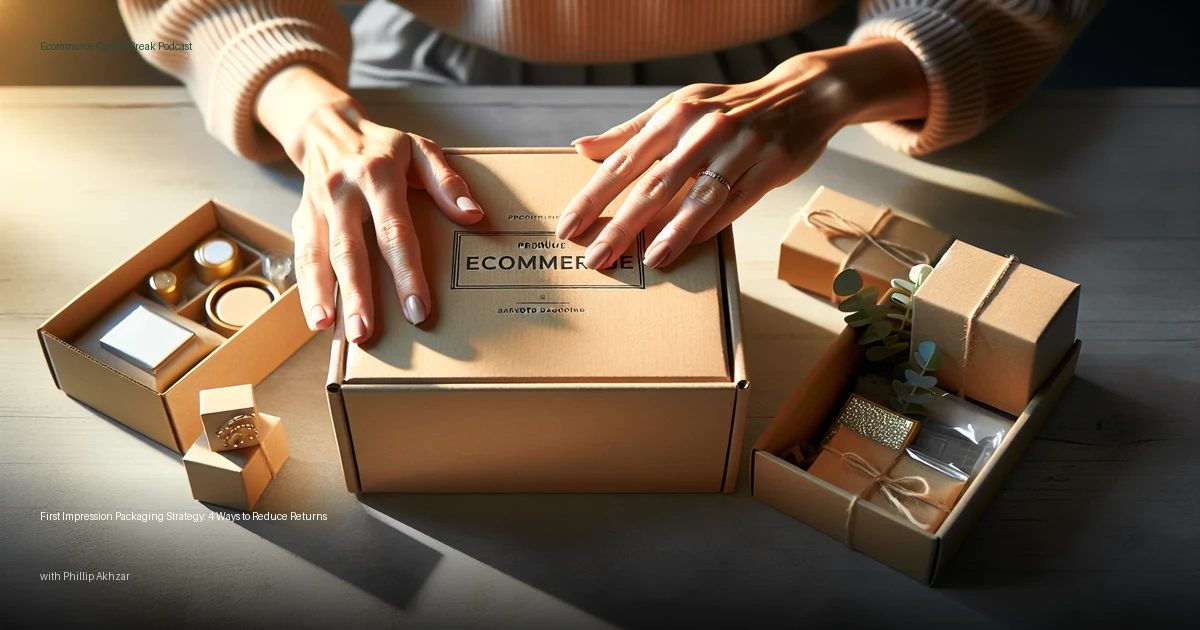
A strategic first impression packaging approach can reduce customer returns by eliminating buyer’s remorse and reinforcing purchase confidence. The key lies in treating packaging as a marketing investment rather than a cost, with targeted premium experiences for first-time customers and seasonal campaigns that align with your product’s perceived value.
Why Your Packaging Creates Conflicting Brand Messages
According to Phillip Akhzar, CEO of Arka.com, many ecommerce businesses unknowingly damage their brand perception through packaging misalignment. “If you’re selling something that’s on par with a Rolex watch, but it shows up in a brown box, that’s conflicting information that you’re sending to your client. They would assume that it’s fake and that it’s not real,” Akhzar explains.
This packaging-product disconnect creates immediate buyer doubt and increases return likelihood. Conversely, businesses selling modest products in well-executed packaging often see elevated brand perception and reduced buyer’s remorse. The solution requires auditing your current packaging against these criteria:
- Value alignment: Does your packaging reflect your product’s price point and quality?
- Brand consistency: Are your packaging colors, fonts, and imagery consistent with your website and marketing materials?
- Unboxing sequence: Does opening your package feel intentional and branded, or rushed and generic?
- Protection quality: Does your packaging protect the product while presenting it attractively?
Research shows customers experience less buyer’s remorse when products arrive in packaging that positively reflects the brand, making them feel confident about their purchase decision.
The Strategic Approach: First Purchase vs. Repeat Orders
Smart ecommerce businesses don’t invest equally in every package. Instead, they strategically allocate packaging budgets for maximum impact. Akhzar recommends a tiered approach: “Maybe just for the first purchase, they have a very extravagant welcome experience for that package saying, thank you for joining our subscription. And then from there on out, every follow on package might just come in a basic polymailer.”
This first impression packaging strategy works because:
- First purchases carry highest return risk: New customers haven’t established trust and are more likely to second-guess their decision
- Premium unboxing creates brand loyalty: A memorable first experience increases customer lifetime value
- Cost efficiency: You’re not overspending on packaging for customers who already trust your brand
- Surprise factor: Unexpected premium packaging exceeds expectations and generates positive reviews
To implement this strategy, create two packaging tiers: a premium “welcome” package for first-time customers and standard packaging for repeat orders. Use your ecommerce platform’s customer data to automatically trigger the appropriate packaging tier.
“Nobody’s asking you to drain your bank account on custom branded packaging. We’re just asking that you treat it as a marketing tool and that you leverage it for the timing that makes sense for your business.” – Phillip Akhzar
Seasonal Packaging: Maximizing Holiday and Campaign Impact
Even small businesses can leverage seasonal packaging for significant impact without major financial commitment. The key is identifying your highest-value periods and investing strategically in those moments.
For most ecommerce businesses, this means focusing on:
- Black Friday/Cyber Monday: When customers are making multiple purchases and comparing experiences
- Holiday gift seasons: When packaging directly impacts the gift-giving experience
- Product launches: When you need to generate buzz and social media shares
- Anniversary or milestone campaigns: When you want to reward loyal customers
Modern packaging technology makes this approach accessible to smaller businesses. Digital printing eliminates traditional tooling costs that previously required thousands of dollars in upfront investment. As Akhzar notes, “With us, you’re able to do, first of all, you are able to do that with us as well. If you’re doing tens of thousands of boxes a month, sure, come to us and we’ll give you the tooling. But if you’re doing smaller runs, and if you’re a smaller merchant… there’s no tooling involved in digital printing.”
This technology shift means you can order as few as 10 custom-branded boxes for a special campaign, then switch to different designs without being locked into expensive tooling investments.
Sustainable Packaging That Reduces Shipping Costs
Sustainability in packaging isn’t just about material choice—it’s about material efficiency. The most impactful change you can make is reducing overall material usage through smarter package design.
Akhzar emphasizes the “ships in its own container” (SIOC) approach: “Make sure that you’re using less material in the first place, whether that material is sustainable or not, use less of it, starting with that. So with SIOC, what we’re able to do is construct a package that has a tray that holds your product safely in place so that it’s not rattling around.”
This approach delivers multiple benefits:
- Reduced shipping costs: Eliminating outer shipping boxes cuts dimensional weight charges
- Lower material costs: Using less packaging material reduces per-order expenses
- Improved sustainability: Less material usage has greater environmental impact than switching materials
- Better unboxing experience: Products presented in fitted trays look more premium
When selecting sustainable materials, prioritize FSC (Forest Stewardship Council) certified options that ensure both sustainable sourcing and production methods. However, always optimize for material reduction first, then focus on sustainable material choices.
Testing and Optimization: The Sample-First Approach
Before committing to large packaging orders, successful businesses test thoroughly with samples. This approach prevents costly mistakes and builds confidence for larger investments.
The modern sampling process has become significantly more accessible and affordable. Where traditional packaging samples once cost hundreds or thousands of dollars and took weeks to produce, digital printing technology now enables fully branded samples for around $20, delivered within days.
When testing packaging samples, evaluate these elements:
- Physical durability: Does the package protect your product during shipping?
- Unboxing experience: Is the opening process smooth and presentation attractive?
- Brand representation: Does the package accurately reflect your brand in person?
- Size optimization: Is the package appropriately sized to minimize waste and shipping costs?
Use sample testing to gather feedback from team members, trusted customers, or focus groups before placing larger orders. This investment in testing typically pays for itself by preventing larger mistakes and building confidence for bigger packaging investments.
Key Takeaways
- Packaging misalignment with product value creates buyer doubt and increases return rates significantly.
- Strategic packaging investment focuses on first-time customers and seasonal campaigns rather than uniform spending across all orders.
- Digital printing technology eliminates traditional tooling costs, making custom packaging accessible to small businesses with orders as low as 10 units.
- Ships-in-own-container (SIOC) design reduces material usage and shipping costs while improving sustainability and presentation.
- Sample testing at $20 per package prevents costly mistakes and builds confidence for larger packaging investments.
- FSC-certified materials ensure sustainable sourcing when combined with material reduction strategies.