

How First-Party Data and AI Are Rewriting the Rules of E-commerce Acquisition
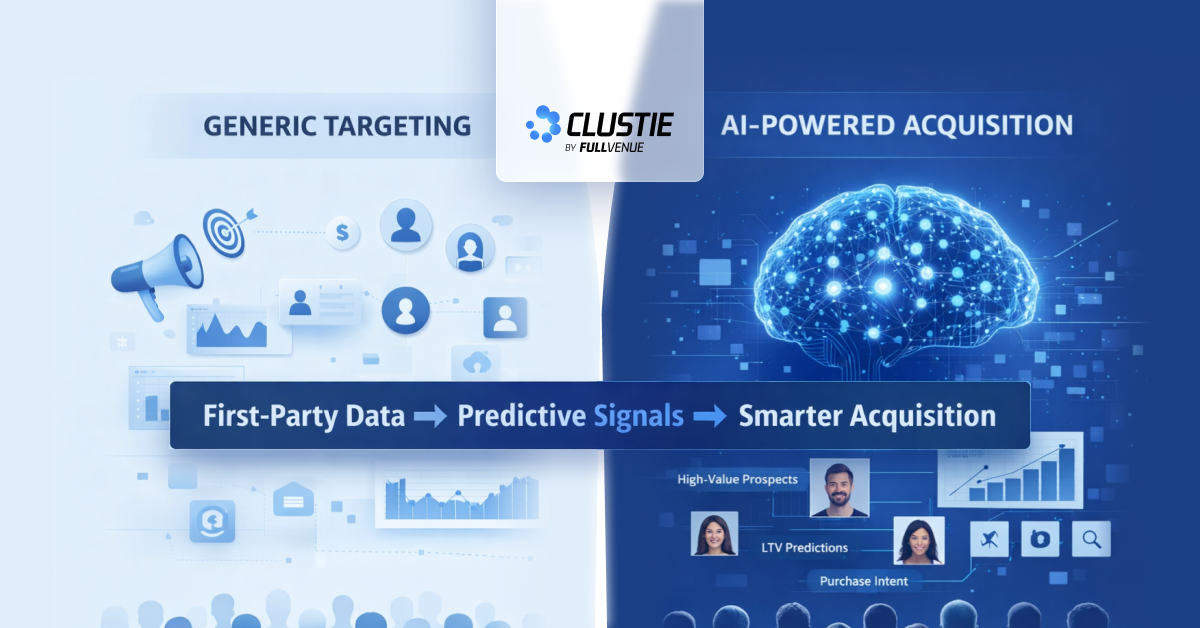
E-commerce acquisition used to follow a predictable pattern. Brands launched campaigns, increased budgets, tested creatives, and gradually scaled what worked. For many years, that approach delivered consistent growth. Today, that playbook is breaking down. Customer acquisition costs keep rising, return on ad spend has become increasingly volatile, and paid media platforms feel harder to control with each passing quarter. For many e-commerce teams, performance no longer scales linearly with spend. The problem, however, is not Meta, Google, or Shopify. The problem is what those platforms are being taught to optimize for.
The real acquisition challenge is signal quality, not budget
Most e-commerce teams believe they have a CPA problem. In reality, they have a signal problem. Paid media algorithms do not think strategically. They learn from the data they receive and optimize accordingly. If the data lacks context or quality, the optimization will follow the same path. For many Shopify brands, the signals sent to advertising platforms are limited to last-click conversions and generic purchase events. There is no distinction between a one-time buyer who never returns and a high-value customer who purchases repeatedly over time. From the algorithm’s perspective, these customers look identical. When every conversion is treated as equal, efficiency inevitably declines.
How the end of third-party data changed acquisition forever
The gradual disappearance of third-party cookies did more than disrupt tracking. It fundamentally reshaped how e- acquisition works. Brands can no longer rely on interest-based targeting, broad lookalike audiences built on shallow data, or platform assumptions about buyer intent. These shortcuts once compensated for weak first-party signals. Today, they no longer do. In this new reality, first-party data has become the most valuable asset an e-commerce brand owns. It reflects real customer behavior, real purchasing decisions, and real value creation. However, owning first-party data alone does not create an advantage. The advantage comes from knowing how to transform that data into action.
First-party data without intelligence remains passive
Most Shopify brands already collect extensive first-party data. They track purchase history, frequency, e-commerce and recency, product affinity, acquisition channels, and time between purchases. On paper, this looks like a goldmine. In practice, much of this data remains underutilized. It lives in dashboards, reports, or spreadsheets, disconnected from the moment where acquisition decisions are made. Teams analyze what happened, but campaigns continue to optimize blindly. Data only becomes valuable when it actively shapes decisions. This is where artificial intelligence changes the equation.
How AI reframes e-commerce acquisition
AI does not replace marketers or strategy. It replaces guesswork. When applied to first-party data, AI can identify behavioral patterns that are invisible to manual analysis. It can predict which customers are likely to repurchase, estimate short- and mid-term customer value, and cluster buyers based on meaningful signals rather than surface-level attributes. Instead of reacting to performance after the fact, e-commerce teams can begin to anticipate outcomes. Acquisition shifts from chasing volume to prioritizing value.
Moving from generic targeting to predictive acquisition
Traditional acquisition strategies focus on optimizing campaigns. Predictive acquisition focuses on optimizing customers. This shift changes the role of paid media platforms entirely. Rather than feeding algorithms raw conversion events, brands can provide enriched signals such as high-propensity buyers, predicted high-LTV customers, fast repeat purchasers, or product-specific buyer clusters. With better signals, algorithms stop optimizing for short-term volume and start optimizing for future value. The result is more stable performance and more sustainable growth.
Why this shift matters especially for Shopify brands
Shopify brands operate in some of the most competitive e-commerce environments. Products, pricing, and creatives are often similar across competitors. Margins are under pressure, and paid media costs continue to increase. In this context, growth is no longer driven by who spends more, but by who makes better decisions. AI-powered first-party data allows Shopify teams to reduce acquisition costs (CPA) without sacrificing scale, stabilize ROAS as budgets increase, and align acquisition with long- term retention from the very first purchase. Instead of constantly reacting to performance fluctuations, teams gain a clearer, calmer path to growth.
The hidden cost of scaling without context
Broad targeting is not inherently flawed. Blind broad targeting is. When campaigns scale without enriched signals, they tend to favor low-friction, discount- driven buyers. These customers may convert quickly, but they often fail to deliver long-term value. Over time, this leads to repeated re-acquisition of low-value users, inflated short-term ROAS, and misleading performance insights. AI-driven segmentation adds the missing context. It allows brands to scale while remaining selective about the type of customers they attract.
Where Clustie fits into this new acquisition model
This is precisely the challenge Clustie was built to address. Clustie connects directly to Shopify and transforms raw customer data into AI-driven predictive audiences. These audiences reflect real purchasing behavior, predicted value, and intent signals. Instead of remaining trapped in dashboards, these insights are synchronized directly into paid media platforms, where acquisition decisions actually occur. The goal is not to generate more data, but to provide better optimization signals. When platforms learn from high-quality first-party signals, acquisition becomes more efficient by design.
What ecommerce teams typically see after activation
When acquisition begins optimizing for predicted value rather than raw conversions, ecommerce teams often observe lower CPA over time, more stable ROAS at higher spend levels, and faster learning cycles within ad platforms. More importantly, acquisition and retention stop working against each other. Growth becomes compounding instead of cyclical.
Practical steps to start today
Brands do not need to rebuild their entire acquisition stack overnight. Meaningful progress often starts with a few foundational steps. Teams should begin by auditing the signals they send to advertising platforms and questioning what those signals truly represent. Segmenting customers by value rather than volume is another critical step, as not all conversions deserve equal weight. Equally important is ensuring that insights reach activation. Data that never touches campaigns cannot create impact. Finally, measuring what happens after the first purchase is essential, as short-term ROAS often hides long-term inefficiencies. That’s exactly the direction Clustie is pointing.
The future of e-commerce acquisition is intentional
High-performing e-commerce teams do not feel frantic. They feel deliberate. When first-party data and AI guide acquisition, testing becomes purposeful, scaling feels controlled, and decisions rely less on instinct. Growth becomes repeatable and resilient rather than reactive. This shift is not a trend. It represents a new operating model for e-commerce acquisition.
Final thought
The brands that will lead the next phase of e-commerce growth will not be the ones that spend the most. They will be the ones who teach algorithms better. First-party data provides the foundation. AI acts as the multiplier. Together, they turn acquisition into a true strategic advantage.
Useful resources:
https://www.shopify.com/enterprise/customer-data
https://www.thinkwithgoogle.com/marketing-strategies/data-measurement/first-party-data/
Learn more
If you are exploring how to move from generic acquisition to value-driven growth, platforms like Clustie are helping Shopify brands turn first-party data into predictive acquisition signals. Clustie connects directly to Shopify, identifies high-intent and high-value customer clusters using AI, and syncs those signals into paid media platforms so algorithms optimize for the customers that actually matter. You can learn more about how Clustie works at https://clustie.ai
Guest post by Tiago Costa, CEO and co-founder of FULLVENUE and Clustie. Tiago works with e- commerce and DTC brands across Europe and the Middle East to turn first-party data into measurable growth through AI-driven acquisition and segmentation.