

How to Recover Failed Payments and Stop Revenue Leaks
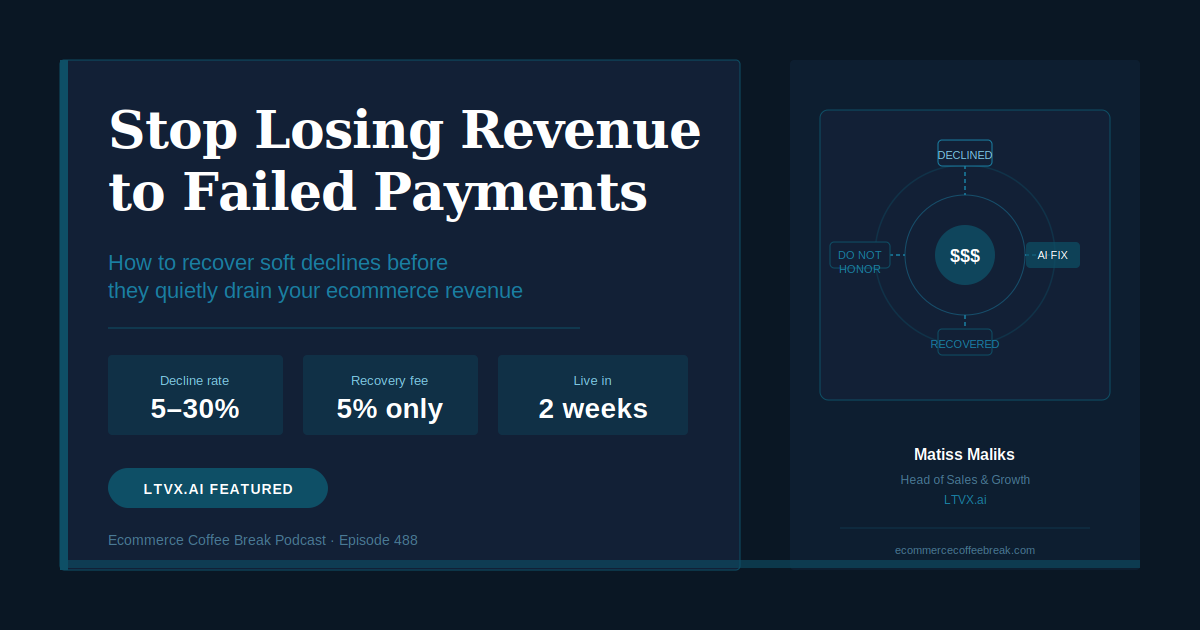
Failed payment recovery for ecommerce brands is the process of identifying and reprocessing declined credit card transactions that your existing payment gateway — Stripe or Shopify Payments — cannot automatically resolve.
Soft declines (also called false declines) affect between 5% and 30% of all transactions depending on your industry and customer base, meaning a significant share of customers who want to buy are being turned away at checkout. By layering a dedicated payment recovery infrastructure on top of your existing setup, brands can recover a large portion of that lost revenue without spending an extra dollar on ads or traffic.
Why Your Payment Approval Rate Is a Hidden Revenue Leak
Most ecommerce operators are wired to optimize the front end: creatives, ad spend, landing page conversion rates, email flows. The back end — specifically what happens to a transaction after a customer clicks "Buy Now" — rarely gets the same attention. That oversight is expensive.
Matiss Maliks, Head of Sales and Growth at LTVX.ai, frames it this way: if you increase ad spend by 30% and traffic rises by 30%, but revenue only climbs 10%, the gap isn't a creative problem or an audience problem. It's a payment infrastructure problem.
The core issue is soft declines — transactions your bank rejects not because the card is invalid or the funds don't exist, but because something in the pattern looks unusual. The most common response code merchants see is "Do Not Honor," which tells you almost nothing. Behind that code can be any number of triggers:
- A cross-border purchase where the bank doesn't recognise the merchant
- A first-time transaction with a new merchant of record
- A purchase amount that flags as suspicious
- Geographic mismatches between the card's issuing bank and the transaction location
Stripe and Shopify Payments are built to process billions of transactions across millions of merchants. That scale-first architecture means they are not optimised to maximise approval rates for your specific customer base, geography, or product category. They retry declined payments by their own logic — not yours.
The result: a portion of your revenue silently disappears every month, written off as lost rather than recoverable.
How to Spot a Payment Problem Before It Kills Your ROAS
The tricky part about payment approval issues is that they disguise themselves as other problems. A drop in checkout conversion rate looks like a UX issue. Rising customer acquisition costs look like an ad fatigue issue. Declining ROAS looks like a targeting issue. In reality, all three can stem from the same root cause: too many legitimate transactions being blocked at the payment layer.
According to Maliks, there are two KPIs every merchant should monitor regularly:
- Initial payment approval rate — what percentage of first-time transactions are successfully processed. If this number is soft, you're losing buyers at the moment of highest purchase intent.
- Checkout page conversion rate — not just add-to-cart, but completed payment. A gap between these two numbers that can't be explained by abandoned carts often points to a backend payment issue.
For subscription businesses, the stakes are even higher. A single failed rebill doesn't just cost you one transaction — it can cost you the entire customer lifetime value. Every failed subscription renewal that doesn't get recovered is a churn event you didn't need to have.
Maliks also flags a critical operational risk that many merchants ignore: if your decline rate climbs too high or your chargeback rate breaches Stripe or Shopify's thresholds, they have the right to freeze your funds without notice. Merchants who rely on a single payment gateway and no backup are one policy breach away from a complete cash flow stop — while ads continue to run and inventory commitments remain in place.
What Payment Recovery Actually Looks Like in Practice
LTVX.ai sits on top of your existing payment infrastructure as a secondary processing layer. When your primary gateway declines a transaction, LTVX's system attempts to identify why — going deeper than the generic error code — and retries the payment through a different path.
The company holds over $10 billion in merchant account capacity and works with more than 20 in-house developers who handle API integration with your checkout. Onboarding follows a defined process:
- Account setup — merchant account created on the LTVX platform
- Compliance and pre-vetting — approximately seven business days for bank-level review of the merchant's business type and processing history
- API integration — connected directly to your checkout; their development team handles the technical side if needed
- Go-live — most merchants are actively recovering declined payments within two weeks of starting the process
The pricing model is performance-only: LTVX takes a 5% fee on recovered revenue. There's no monthly retainer, no setup fee, no minimum volume commitment. If they don't recover anything, they don't charge anything.
To illustrate the real-world impact, Maliks described a merchant processing approximately $2 million per month who was experiencing a significant volume of declined transactions. The merchant had over ten media buyers and a full operations team — but no one specifically watching the payment approval layer. Without increasing ad spend, redesigning the checkout, or acquiring a single new customer, the merchant was able to recover a meaningful portion of revenue that had previously been written off entirely.
"We're not asking merchants to find more customers. We're showing them how the same customers can bring them more money — by simply approving more of what they already have."
— Matiss Maliks, Head of Sales and Growth, LTVX.ai
Which Merchants Benefit Most From Payment Recovery Tools
Not every business sees the same results, and it's worth being clear-eyed about where payment recovery delivers the strongest ROI.
Highest impact:
- Subscription brands — where each recovered rebill protects LTV, not just a single-order value
- High-AOV merchants — where a 5–10% recovery rate on declined orders translates to significant absolute revenue
- SaaS and app companies — where purchase intent is clear and decline reasons are typically soft rather than fraud-related; Maliks notes recovery rates of 25–30% are achievable in these categories
- International sellers — especially those selling into Latin America, CIS countries, or other regions where bank approval logic is more conservative and cross-border declines are structurally high
Lower impact (but still worth auditing):
- High-risk merchants in grey-area categories, where customer intent at the time of billing can be ambiguous — Maliks cites recovery rates as low as 5–10% for some of these
- Very early-stage brands with low transaction volume, where the absolute dollar recovery may not justify the compliance onboarding time
The key question isn't whether you have declined payments — every merchant does. The question is whether you have any visibility into why they're declining and any infrastructure in place to recover them. Most brands, even at seven-figure monthly revenue, do not.
Maliks also offers a practical piece of risk management advice that applies regardless of whether you use a payment recovery tool: never rely on a single payment gateway. Having multiple acquirers and payment processing relationships in place means that if one gets frozen or suspended — which happens regularly, often without warning — you have a path to continue processing while you resolve the issue.
Key Takeaways
- Soft declines (false declines) affect 5–30% of ecommerce transactions and represent revenue from customers who intended to complete a purchase but were blocked by payment infrastructure, not lack of intent.
- The most common decline code — "Do Not Honor" — provides no actionable information to merchants and is the primary target for AI-driven payment recovery systems like LTVX.ai.
- Two KPIs signal a payment problem before it becomes critical: initial payment approval rate and checkout page conversion rate; a gap between ad spend increases and proportional revenue growth is a strong indicator.
- Stripe and Shopify Payments are optimised for processing scale, not for maximising approval rates on a per-merchant basis — dedicated payment recovery infrastructure fills this gap.
- High-chargeback or high-decline rates can trigger account freezes by Stripe or Shopify, making payment diversification and recovery infrastructure both a revenue opportunity and a business continuity strategy.
- LTVX.ai operates on a 5% success fee with no monthly cost, meaning merchants only pay when declined revenue is actually recovered — making it a zero-risk audit starting point for brands processing significant monthly volume.
This article is based on insights shared by Matiss Maliks, Head of Sales and Growth at LTVX.ai, on the Ecommerce Coffee Break Podcast. Listen to the full conversation: How To Recover Failed Payments And Boost Approval Rates With Matiss Maliks
- Share: