Partner With Us. Reach 70K Ecom Operators. Learn more Ecommerce Coffee Break Podcast and Newsletter

Ecommerce Coffee Break Ecommerce Coffee Break
  • HOME
  • PODCAST
    • Browse All Episodes
    • Playlists By Topic
    • Be a Podcast Guest
    • Suggest a Guest
  • NEWSLETTER
    • Subscribe
    • Past Issues
    • Advertise
  • PARTNERS
  • PARTNER WITH US
    • Be a Podcast Guest
    • Advertise/Sponsor
  • REVIEWS
    • Reviews
    • Rate on Apple Podcasts
    • Rate on Spotify
  • SUBSCRIBE
    • Email Newsletter
    • Apple Podcasts
    • Spotify
    • YouTube
    • iHeart
    • Amazon Music
    • Overcast
    • Castbox
    • Podurama
    • RSS Feed
  • ABOUT US
  • HOME
  • PODCAST
    • Browse All Episodes
    • Playlists By Topic
    • Be a Podcast Guest
    • Suggest a Guest
  • NEWSLETTER
    • Subscribe
    • Past Issues
    • Advertise
  • PARTNERS
  • PARTNER WITH US
    • Be a Podcast Guest
    • Advertise/Sponsor
  • REVIEWS
    • Reviews
    • Rate on Apple Podcasts
    • Rate on Spotify
  • SUBSCRIBE
    • Email Newsletter
    • Apple Podcasts
    • Spotify
    • YouTube
    • iHeart
    • Amazon Music
    • Overcast
    • Castbox
    • Podurama
    • RSS Feed
  • ABOUT US
  • Home
  • Content Hub
  • Automated Internal Linking Strategy for Ecommerce SEO Success

Content Hub

18 Apr

Automated Internal Linking Strategy for Ecommerce SEO Success
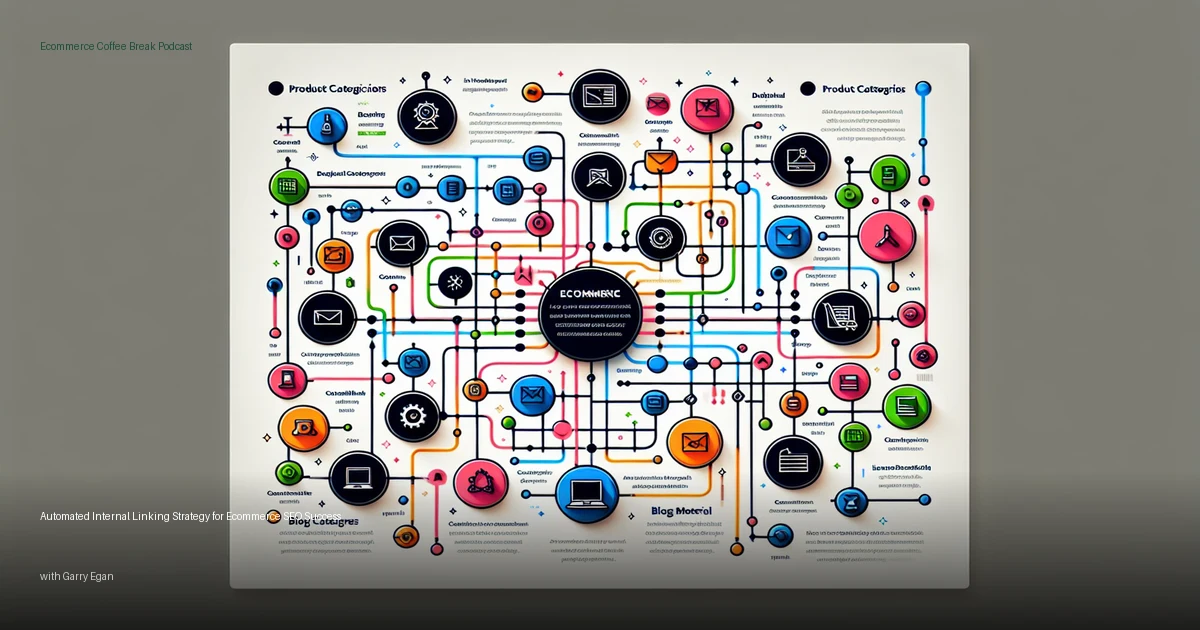
An automated internal linking strategy connects your content through contextual keywords that funnel customers to conversion pages without manual link creation. This approach increases customer retention time, improves user experience, and creates systematic pathways from blog posts to product collections and checkout pages.

The Three-Pillar SEO Framework for Ecommerce Success

According to InterLinks founder Garry Egan, effective SEO boils down to three core goals that work together like a “three-legged stool.” Understanding this framework helps you build an automated internal linking strategy that serves each objective.

Awareness gets your store visible in search results. Your content needs to be discoverable, addressing the age-old question of whether a tree falling in an empty forest makes a sound. Without visibility, even the best products remain unseen.

Consideration guides visitors once they land on your pages. This is where your automated internal linking strategy becomes crucial—you need contextual links that naturally lead users from blog posts to category pages, and from categories to specific products.

Conversion completes the customer journey. Whether that’s an add-to-cart action, newsletter signup, or contact form submission, your link structure should create clear pathways to these conversion events.

This systematic approach ensures every piece of content serves a purpose in your customer acquisition funnel, rather than existing as isolated pages that fail to drive business results.

Strategic Keyword Selection Using Google’s Own Data

Choosing the right keywords for your automated internal linking strategy doesn’t require expensive tools or complex analysis. Egan reveals a simple but powerful method: “Go to Google, Google it, scroll to the bottom, and you’ll see the related phrases. But there’s 10 of them. They’re in a block. Grab all of them.”

Here’s how to implement this approach:

  • Start with your primary keyword – the main term you want your page to rank for
  • Search that term on Google and scroll to the “Searches related to” section at the bottom
  • Collect 7-8 related phrases (not all 10, to avoid appearing artificial)
  • Incorporate these naturally into your content as paragraph headers or contextual mentions
  • Link these related terms to relevant category or product pages

This method works because you’re literally using Google’s own understanding of topic relationships. When you include these semantically related terms with appropriate internal links, you’re speaking directly to the search algorithm’s comprehension of your content’s relevance and authority.

For ecommerce stores, this might mean linking “waterproof hiking boots” to your outdoor footwear collection, while “trail running shoes” connects to your athletic category. Each related term becomes a bridge between content consumption and product discovery.

The Art of Strategic Link Placement

The location and context of your internal links significantly impact both user experience and SEO value. Research shows that users place much higher credibility on links within body content compared to navigation or sidebar links.

Blog Post Linking Rules:

  1. Place links within the first few scrolls – Don’t let users read through multiple paragraphs without encountering a relevant internal link
  2. Use contextual anchor text – Instead of “click here,” use descriptive phrases that match your target page’s primary keyword
  3. Link to category pages from blog content – This creates a natural funnel from informational content to shopping experiences
  4. Maintain relevance – As Egan notes, “why would you want to have auto parts on a credit card store? It doesn’t make any sense, right? And Google thinks the same thing.”

Product Page Link Strategy:

On product detail pages, the opposite approach applies. Once visitors reach a potential conversion page, minimize external linking. “I’ve got you right where I want you,” explains Egan. “I don’t want you leaving this page anymore.” This means removing social media share buttons, limiting related product suggestions, and focusing entirely on the add-to-cart action.

“We are humans and we are trying to talk to search engines. So if you built a search engine, what would you look for on the page? You would look for certain phrases, and then you would reverse those out to a core phrase and say, ‘I think your page is about this top topic because you have a lot of these sub topics under it.'” – Garry Egan

Implementing Automated Linking at Scale

For stores with thousands of products and extensive blog content, manual link creation becomes impossible to maintain. An automated internal linking strategy solves this through systematic keyword-to-collection mapping.

The Onboarding Process:

  1. Audit your collections – List all product categories and main landing pages
  2. Assign trigger keywords – For each collection, identify 1-2 words that should automatically link to it
  3. Set up automation rules – Configure your system so that whenever these keywords appear in content, they automatically become contextual links
  4. Test and refine – Monitor which automated links generate the most traffic and conversions

This approach allows you to retroactively optimize existing content while ensuring all future blog posts automatically include relevant internal links. For enterprise-level stores, this can mean implementing hundreds or thousands of keyword-to-collection relationships through CSV imports or API integrations.

Security and Technical Considerations:

When implementing automated linking, consider the technical infrastructure. Egan emphasizes the importance of secure implementations: “I made it so the links are encrypted on the database. Not even interlinked staff can view links on the database.” This level of security becomes crucial for enterprise implementations where link data represents competitive intelligence.

Key Takeaways

  • Successful SEO requires balancing awareness, consideration, and conversion through strategic internal linking.
  • Use Google’s “related searches” section to identify semantically relevant keywords for natural content optimization.
  • Place contextual links within blog content early and frequently, but eliminate external links from product pages to prevent conversion abandonment.
  • Automated internal linking systems allow enterprise stores to maintain consistent optimization across thousands of products and pages.
  • Security considerations become critical when implementing automated linking at scale, requiring encrypted link data and secure server infrastructure.
  • The most effective internal links use relevant anchor text that matches target page keywords rather than generic phrases like “click here” or “learn more.”
How do I choose the right keywords for automated internal linking?
Start with your main keyword, search it on Google, and collect 7-8 related phrases from the “Searches related to” section at the bottom of results. These related terms should naturally connect to your product categories and collections through contextual links.
 
Should I include social media links on product pages?
No, product detail pages should minimize external links including social sharing buttons. Once customers reach a conversion page, focus entirely on the purchase decision rather than providing opportunities to leave your site.
 
What’s the difference between manual and automated internal linking?
Manual linking requires creating each link individually within content, while automated systems use keyword triggers to generate contextual links whenever specific terms appear. Automated linking scales better for large stores but requires careful setup and security considerations.
 
This article is based on insights shared by Garry Egan on the Ecommerce Coffee Break Podcast. Listen to the full conversation: How To Create Automated Links to Anywhere | #211 Garry Egan
Tags:automated linksecommerce seointernal linkinglink buildinguser experience
  • Share:
Ecommerce Coffee Break Podcast

Search Site

LISTEN ON

Apple Podcast itunes Spotify

YouTube Logo Overcast Logo

Castbox Logo Podurama Logo

iHeart Radio Subscribe by Email

Latest Episode

How to Build Customer Loyalty Through Product Innovation — Nathan Yun | How Product Innovation Drives Loyalty, What Paire Learned From Buyer Feedback, Why Brands Focus on Customer Retention, How Fabric Tech Solves Apparel Issues (#506)
12Oct,2026

SUPPORT OUR PARTNERS

XERO
Bizrate Insights
Free Ecommerce Guides

Rankings & Awards

FeedSpot Logo
Global-Podcast-Rank

Who should we interview next? Who would make a great guest? Let us know.

Suggest a Guest

The Ecommerce Coffee Break — The B2B Media Platform Built to Connect the Ecommerce Industry. Discover the sales and marketing strategies top ecommerce brands actually use to grow revenue faster.

Get the Free Newsletter for Ecommerce Operators
  • Home
  • About
  • Episodes
  • Partner with Us
  • Newsletter
  • Rankings & Awards
  • Media Kit
  • Community
  • Guest Application
  • Content Hub
  • Contact
  • Free Resources

LISTEN ON

  • Apple Podcasts
  • Spotify
  • Amazon Music
  • YouTube Music
  • Castbox
  • RSS Feed
  • iHeart Radio

Follow on Social

LinkedIn Claus Lauter Facebook Claus Lauter Twitter Claus Lauter Instagram Claus Lauter YouTube Claus Lauter

☕ 100% powered by caffeine and curiosity. Disclaimer: The Ecommerce Coffee Break is independent media not affiliated with or endorsed by Amazon™, Shopify™, or any third party.

© 2019–2026 idube Pte Ltd. All Rights Reserved.

  • Home
  • Privacy
  • Terms
  • Disclaimer
  • Cookie Policy
  • Imprint
  • Sitemap
Manage Consent
To provide the best experiences, we use technologies like cookies to store and/or access device information. Consenting to these technologies will allow us to process data such as browsing behavior or unique IDs on this site. Not consenting or withdrawing consent, may adversely affect certain features and functions.
Functional Always active
The technical storage or access is strictly necessary for the legitimate purpose of enabling the use of a specific service explicitly requested by the subscriber or user, or for the sole purpose of carrying out the transmission of a communication over an electronic communications network.
Preferences
The technical storage or access is necessary for the legitimate purpose of storing preferences that are not requested by the subscriber or user.
Statistics
The technical storage or access that is used exclusively for statistical purposes. The technical storage or access that is used exclusively for anonymous statistical purposes. Without a subpoena, voluntary compliance on the part of your Internet Service Provider, or additional records from a third party, information stored or retrieved for this purpose alone cannot usually be used to identify you.
Marketing
The technical storage or access is required to create user profiles to send advertising, or to track the user on a website or across several websites for similar marketing purposes.
  • Manage options
  • Manage services
  • Manage {vendor_count} vendors
  • Read more about these purposes
View preferences
  • {title}
  • {title}
  • {title}
Manage Consent
To provide the best experiences, we use technologies like cookies to store and/or access device information. Consenting to these technologies will allow us to process data such as browsing behavior or unique IDs on this site. Not consenting or withdrawing consent, may adversely affect certain features and functions.
Functional Always active
The technical storage or access is strictly necessary for the legitimate purpose of enabling the use of a specific service explicitly requested by the subscriber or user, or for the sole purpose of carrying out the transmission of a communication over an electronic communications network.
Preferences
The technical storage or access is necessary for the legitimate purpose of storing preferences that are not requested by the subscriber or user.
Statistics
The technical storage or access that is used exclusively for statistical purposes. The technical storage or access that is used exclusively for anonymous statistical purposes. Without a subpoena, voluntary compliance on the part of your Internet Service Provider, or additional records from a third party, information stored or retrieved for this purpose alone cannot usually be used to identify you.
Marketing
The technical storage or access is required to create user profiles to send advertising, or to track the user on a website or across several websites for similar marketing purposes.
  • Manage options
  • Manage services
  • Manage {vendor_count} vendors
  • Read more about these purposes
View preferences
  • {title}
  • {title}
  • {title}

Become a smarter online seller in 3 minutes

Free weekly newsletter read by 15,000+ Shopify merchants, Amazon sellers, and DTC brands.

Join 100% free • Twice a week • Unsubscribe anytime