

How AI Visual Testing Fixes Amazon Listings That Don’t Convert
Why Your Amazon Listings Get Clicks But No Sales — And How to Fix It With AI-Powered Visual Testing
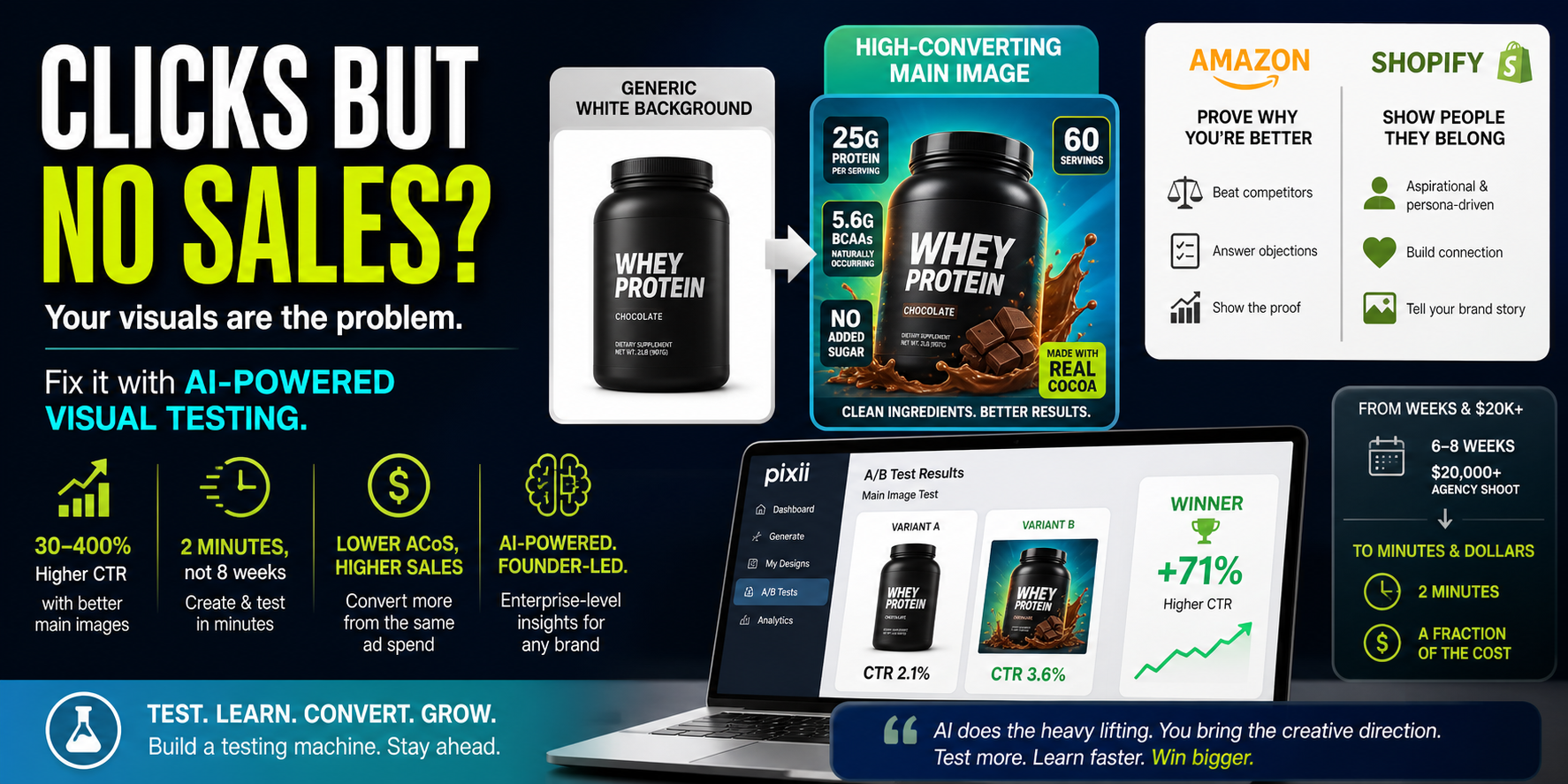
Most e-commerce brands focus on the wrong problem. They polish their copy, tighten their bullet points, and assume a steady stream of clicks will eventually convert. But if your Amazon or Shopify product detail pages aren't turning browsers into buyers, the culprit is almost always your visuals — and the solution is systematic, AI-powered image testing at a scale that was previously reserved for brands spending millions. Amazon listings get clicks but no sales primarily because the product images fail to answer the buyer's core questions — why this product, why now, why better than the competitor sitting two tiles away. High-converting listings use a deliberate sequence of visuals that communicate benefits, build trust, and tell a brand story tailored to a specific customer. The fastest way to find what works for your product is continuous visual A/B testing, which AI tools now make possible for solo founders and small teams in minutes rather than months.
1. The Real Reason Viral Brands Keep Winning (Hint: It's Not the Aesthetic)
It's tempting to look at brands like AG1, Olly, or Magic Spoon and conclude that their distinctive visual style is what drives their success. So you swipe their color palette, replicate their layout, and wait. Nothing happens. Monte Desai, founder of Pixii.ai — an AI design tool trained on over 100,000 top-performing Amazon listings used by brands generating more than $10 billion in combined revenue — has watched this mistake play out thousands of times across the platform's users. "The number one rule of marketing is: who is your customer, what is their problem, and how are you the best solution?" Desai explains. "When you copy a competitor's design, you're copying their answer to a question about their customer — not yours." What those winning brands actually share is not a look. It's a process. They test relentlessly. New main images every few weeks. Gallery refreshes aligned to seasonal moments — Easter, Father's Day, graduation season, summer. Separate landing pages for separate customer personas. Some scaling brands, Desai notes, have entire teams dedicated exclusively to main image testing — one photo, one title, the only two things a shopper sees before deciding whether to click. The actionable takeaway: stop trying to find the winning image. Start building a system to test your way to it.
2. The Main Image Is Your Most Valuable Real Estate — Treat It That Way
On Amazon, your main image and title are doing all the heavy lifting before a single person lands on your listing. According to Desai, brands that invest seriously in main image optimisation routinely see 30% higher click-through rates — and in some cases, improvements of 300–400% when they move from a generic white-background shot to something that earns attention in a crowded search results page. What kinds of changes produce that kind of lift? Often surprisingly small ones:
- A splash of color that breaks the visual monotony of a category page
- A badge or callout — "60 loads," "sugar-free," "dermatologist tested" — that answers an objection before the shopper even clicks
- Showing an ingredient — jasmine flowers, activated charcoal, real fruit — that signals quality and transparency
- Lifestyle context placed in the main image itself, giving the buyer an instant sense of who this product is for
The catch? No formula works forever. Once a winning approach spreads across a category, it becomes noise. A protein powder brand that was first to show a dramatic color splash on their main image has an advantage — until every competitor copies it, and they're back in a sea of sameness. This is why the brands growing from $20 million to $50 million in a single year aren't searching for a silver bullet. They're building a testing machine. For small brands and solo founders, the obstacle has always been resources: photo shoots cost $20,000 and take six to eight weeks. AI-powered tools like Pixii.ai compress that timeline to two minutes and a fraction of the cost, making continuous testing financially viable for the first time.
3. Amazon vs. Shopify: Your Listing Strategy Should Be Completely Different
One of the most overlooked mistakes in e-commerce visual strategy is treating Amazon and Shopify as the same canvas. They require fundamentally different storytelling approaches — and brands that port the same image set across both channels are leaving conversion on the table on at least one of them. On Amazon, your listing exists in a competitive marketplace where your rivals are literally displayed alongside your product. The visual job of your gallery is to win a direct comparison: more protein per serving, better ingredients, superior customer reviews, clearer usage instructions. Every image needs to answer an objection or reinforce a reason to choose you over the five competing products visible on the same screen. Infographics, comparison charts, nutritional breakdowns, and "how it works" explainers are not optional — they're the core conversion mechanism. On Shopify, the dynamic shifts completely. The shopper has already left the marketplace and arrived on your turf. There are no competitors on your product page. The brand has more latitude to be aspirational, emotional, and persona-specific. A protein shake brand on Shopify might show a female endurance athlete in one set of images, a gym-going male in another, and a beginner wellness seeker in a third — each set living on a separate landing page, tested against each other to maximise conversion for that specific audience segment. Desai frames it simply: on Amazon you prove why you're better; on Shopify you show people they belong.
4. How AI Visual Tools Are Leveling the Playing Field for Small Sellers
Before AI, the gap between enterprise brands and solo founders on visual testing wasn't just about budget — it was about institutional knowledge. Fortune 500 brands had conversion rate optimisation specialists, dedicated main image teams, and agencies with years of category-specific data. A side-hustler running a supplement brand out of their garage had one product photo and a Canva template. That gap is closing fast. Pixii.ai, for example, requires just one product photo and a basic product description — or even just a link to an existing Amazon or Shopify listing — to generate seven platform-optimised visuals in approximately two minutes. Those visuals are not static AI images that can't be edited; they're fully editable designs in a drag-and-drop interface, meaning a brand can adjust layouts, swap text, and iterate without prompt-engineering gymnastics or starting from scratch. Skin Perfection founder Carrie Thomas, who carries around 80 SKUs across multiple platforms, completed her entire Amazon gallery refresh using Pixii in a single week — work she estimated would have cost $240,000 through an agency. In her first listing alone, she calculated a saving of $3,000 compared to agency rates. A separate home décor brand cut their advertising cost of sales in half within two weeks of refreshing their listings — not by spending more on ads, but by giving shoppers clearer answers to the questions their previous images left open. How does this shelf mount? How much weight does it hold? Once those questions were answered visually, the same ad spend generated dramatically more revenue.
"I would never trust a freelancer or VA to do my designs because they don't understand my product — but I trust Pixii because it does that thinking and analysis for you." — Carrie Thomas, Skin Perfection, as cited by Monte Desai on the Ecommerce Coffee Break Podcast
The implications extend beyond cost savings. When AI handles production and a founder handles creative direction, the testing velocity that was previously the exclusive domain of well-funded brands becomes accessible to anyone. More tests mean more data. More data means faster revenue growth off the same ad spend. It's a compounding advantage — and the window to capture it before competitors do is narrow.
Key Takeaways
- Amazon listings that get clicks but no sales typically have a visuals problem, not a copy problem — images must answer buyer objections and competitive comparisons directly.
- The most consistently successful e-commerce brands share one habit: continuous visual A/B testing of main images, gallery sequences, and seasonal creative — not a single "winning" image.
- Main image optimisation alone can increase Amazon click-through rates by 30–400%, making it the single highest-leverage conversion lever on the platform.
- Amazon and Shopify require distinct visual strategies: Amazon demands direct competitive differentiation; Shopify rewards aspirational, persona-driven brand storytelling.
- AI-powered design tools like Pixii.ai enable solo founders to generate, edit, and test platform-optimised product visuals in minutes — compressing a process that previously took weeks and cost thousands.
- Brands using AI-generated listing visuals have reported halving their advertising cost of sales within two weeks, by converting more traffic from their existing ad spend rather than increasing budgets.
This article is based on insights shared by Monte Desai on the Ecommerce Coffee Break Podcast. Listen to the full conversation: Why Your Amazon Listings Get Clicks But No Sales — Episode 475 with Monte Desai of Pixii.ai