

AI-Powered Print on Demand for Ecommerce Beginners
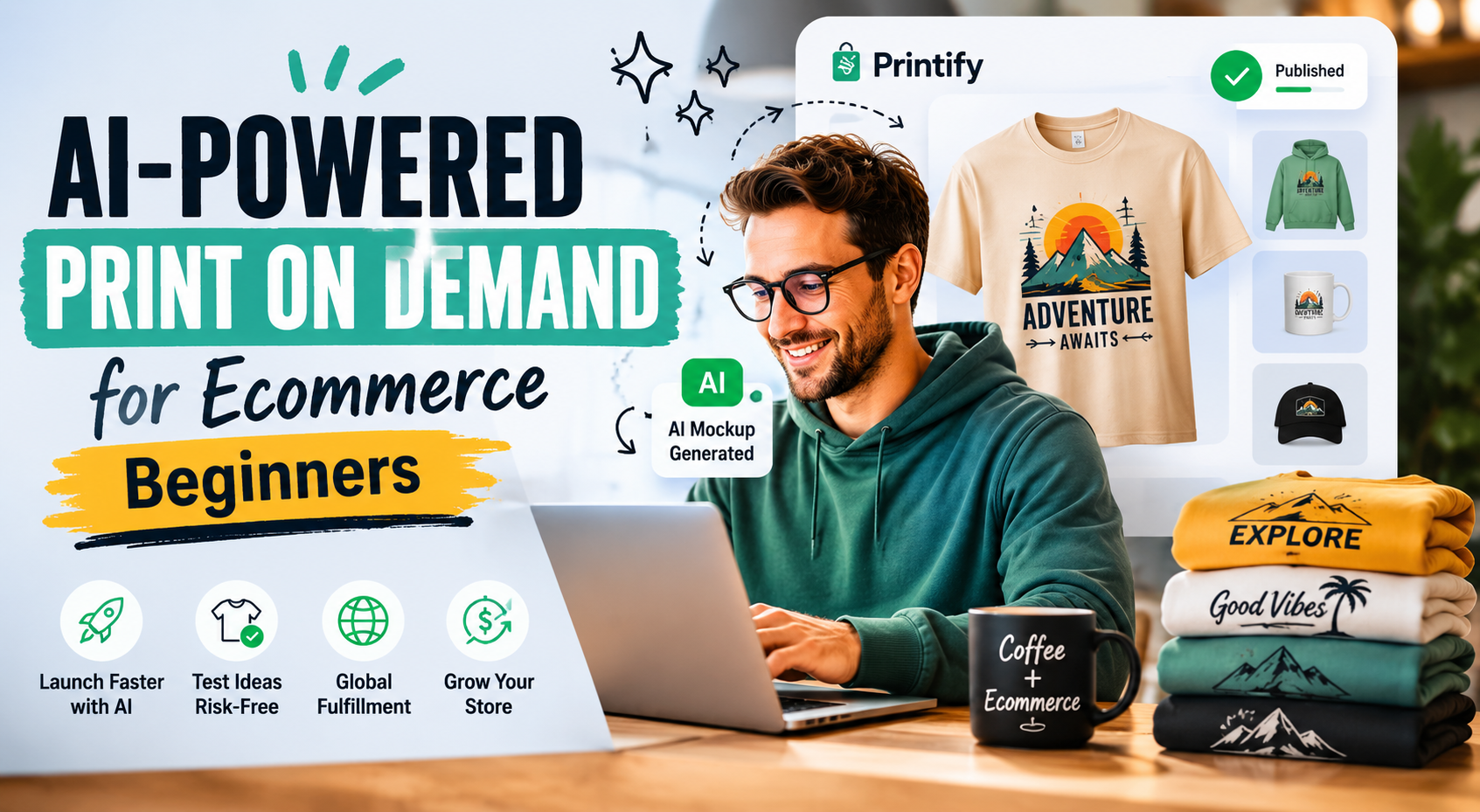
How to Start a Low-Risk Ecommerce Business With AI-Powered Print on Demand
If you want to start an online store without buying inventory upfront, AI-powered print on demand is one of the lowest-risk ecommerce business models available today. Modern platforms such as Printify combine on-demand manufacturing, global fulfillment, and AI tools that help entrepreneurs create products, generate mockups, and launch stores faster than ever before.
For new sellers, success comes from testing ideas quickly, understanding a specific audience, and using automation to remove repetitive tasks rather than trying to predict the perfect product before launch.
1. Use AI-Powered Print on Demand to Validate Ideas Before Investing Capital
One of the biggest mistakes ecommerce entrepreneurs make is investing heavily in inventory before validating demand. Traditional product businesses often require large minimum order quantities, storage space, fulfillment processes, and significant upfront cash.
Print on demand changes that equation completely.
Instead of purchasing hundreds of products in advance, items are produced only after a customer places an order. This allows entrepreneurs to test multiple product ideas with minimal financial risk.
David Hooker, Head of Brand at Printify, explained that the model removes many of the operational barriers that traditionally prevent people from starting an ecommerce business. Sellers can focus on creating products and attracting customers while production and fulfillment happen behind the scenes.
This flexibility is particularly valuable in today's market where consumer preferences change rapidly.
Rather than betting everything on a single product, entrepreneurs can launch multiple designs, niches, or product categories and let customer demand reveal the winners.
A practical example comes from a merchant Hooker referenced who uploaded numerous designs that failed to gain traction. The design the seller believed was only moderately interesting unexpectedly became a breakout success, generating more than 1,000 orders after a single successful advertising campaign.
The lesson is clear: market feedback matters more than personal opinion.
When using AI-powered print on demand for ecommerce beginners, the goal is not to find the perfect product immediately. The goal is to test ideas quickly and cheaply until customers show you what they actually want.
2. Increase Your Chances of Success by Creating More “Fishing Lines”
Many ecommerce operators fail because they become emotionally attached to a small number of products.
Successful sellers take the opposite approach.
Hooker shared an analogy from one successful merchant who compares product creation to fishing. If you place one fishing line in the water, you might catch a fish. If you place ten lines in the water, your chances increase dramatically.
The same principle applies to ecommerce.
Every product listing represents another opportunity to attract customers, gather data, and generate revenue.
Historically, creating large numbers of products required significant time and effort. Sellers needed to design graphics, write descriptions, create product images, organize categories, and upload listings manually.
AI is changing that process.
Modern tools can assist with:
- Product descriptions
- Store setup
- Category selection
- Tag generation
- Mockup creation
- Product image generation
By reducing repetitive work, sellers can spend more time testing ideas and less time performing administrative tasks.
David Hooker argues that AI's greatest opportunity is removing work entrepreneurs never wanted to do in the first place, allowing them to focus on creativity, experimentation, and business growth.
This shift is particularly important because success in ecommerce often comes from volume of experimentation rather than perfect execution on a single idea.
The faster you can launch, test, and learn, the faster you can identify winning products.
3. Know Your Audience Better Than Your Competitors
If there was one recurring theme throughout the conversation, it was the importance of understanding customers.
According to Hooker, the most successful sellers consistently demonstrate three characteristics:
- Resilience
- Deep audience knowledge
- The ability to adapt as customer preferences evolve
Many sellers focus heavily on product design while neglecting audience research. Yet customers rarely buy products simply because they look good.
They buy products that reflect identity, beliefs, interests, humor, communities, or aspirations.
One of the most memorable examples involved a merchant living in Spain who successfully sells products to a niche audience of Ohio-based nurses who love cats.
The seller is not part of that audience.
However, he took the time to understand what that community values, how they communicate, and what types of products resonate with them.
That knowledge created a competitive advantage.
For ecommerce brands, audience research should include:
- Online communities and forums
- Social media groups
- Customer reviews
- Email surveys
- Competitor analysis
- Trend monitoring
Interestingly, Hooker highlighted email marketing as one of the most underrated channels available today.
While many marketers focus on newer platforms, email remains one of the best ways to gather feedback, build relationships, and stay aligned with changing customer preferences.
The brands that continue listening after the first sale are often the brands that continue growing.
4. Use AI Mockups to Stand Out in Crowded Marketplaces
Product presentation has always been one of the biggest challenges in print on demand.
Customers want to see products in realistic environments before they buy.
Traditionally, sellers had two choices:
- Pay for professional photography
- Use generic template mockups
Professional photography is expensive and time-consuming. Template mockups often look identical to competitors using the same platform.
AI-generated mockups are changing the game.
Printify recently introduced AI-powered mockup generation that allows sellers to create realistic lifestyle images using guided prompts. Instead of displaying products on the same stock models used by thousands of other stores, sellers can generate unique imagery tailored to their target audience.
This matters because visual differentiation can significantly impact click-through rates and conversion rates.
Consumers increasingly expect personalized experiences. Gen Z shoppers, in particular, often seek products that feel unique and individual rather than mass-produced.
Better product imagery helps communicate that uniqueness.
The technology has also improved dramatically. Hooker noted that many outdated assumptions about AI-generated images no longer apply. Modern image models can create highly realistic visuals that closely resemble professional photography.
For entrepreneurs using AI-powered print on demand for ecommerce beginners, this means creating premium-looking storefronts without investing thousands of dollars in photography and design resources.
Key Takeaways
- Print on demand allows entrepreneurs to launch ecommerce businesses without purchasing inventory upfront.
- AI tools help automate repetitive tasks such as mockup creation, product descriptions, tagging, and store setup.
- The most successful sellers consistently test new products instead of relying on a single idea.
- Understanding customer communities is often more important than design skill.
- Email marketing remains one of the most effective channels for gathering customer feedback and building loyalty.
- AI-generated product mockups can help ecommerce brands create more distinctive and engaging product listings.
This article is based on insights shared by David Hooker, Head of Brand at Printify, on the Ecommerce Coffee Break Podcast. Listen to the full conversation: How AI is Revolutionizing Print on Demand