

AI Audience Intelligence for Ecommerce Brands
Why AI Audience Intelligence Is Becoming Essential for Ecommerce Growth
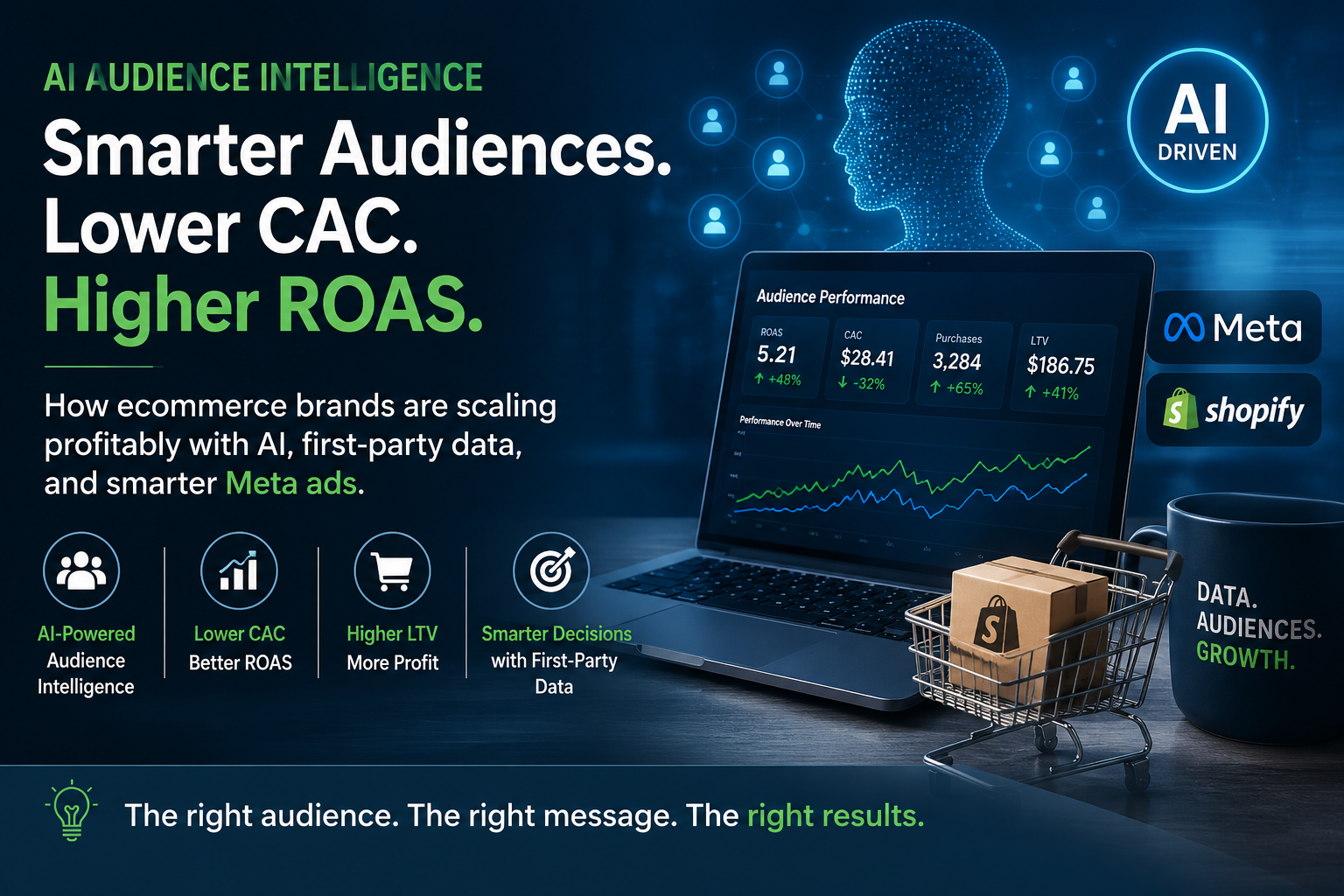
Scaling an ecommerce brand in 2026 is no longer just about buying more ads. Rising customer acquisition costs, crowded paid channels, and inconsistent performance tracking are forcing brands to rethink how they grow. The brands winning today are using AI audience intelligence for ecommerce brands to improve targeting, increase ROAS, and reduce wasted spend.
During a recent Ecommerce Coffee Break Podcast episode, ecommerce operator Rafael Tomé and Full Venue CEO Tiago Costa explained why audience intelligence is becoming one of the most important growth levers for modern ecommerce companies. Their insights reveal a major shift happening inside Shopify brands: the companies growing fastest are no longer relying on guesswork or broad targeting. Instead, they are using first-party data, predictive audiences, and smarter campaign structures to scale more efficiently.
Direct Answer
The fastest-growing ecommerce brands are improving profitability by using AI audience intelligence to identify high-value buyers, reduce customer acquisition costs, and simplify ad campaign structures. Instead of launching more campaigns or increasing ad budgets blindly, successful brands are focusing on first-party customer data, predictive targeting, and stronger ecommerce fundamentals like average order value and lifetime value.
1. Fix Your Ecommerce Metrics Before You Scale Paid Ads
One of the clearest themes from the conversation was that many ecommerce founders try to scale too early.
According to Rafael Tomé, most operators focus heavily on creative ideas and products but ignore the core business metrics needed to scale sustainably. He emphasized that brands need to understand their economics before increasing ad spend.
“You’ve got to have your average order value and lifetime value correct before you start scaling.” — Rafael Tomé
This is where many Shopify stores fail. They assume poor ad performance is caused by Facebook or Meta, when the real issue is often weak unit economics.
Before increasing your paid media budget, focus on these metrics first:
- Average Order Value (AOV): Can you increase bundle sizes or upsells?
- Lifetime Value (LTV): Are customers coming back for repeat purchases?
- Customer Acquisition Cost (CAC): Is your margin strong enough to support scaling?
- Contribution Margin: Are your campaigns profitable after fulfillment and operational costs?
- Repeat Purchase Rate: Are you building a long-term customer base?
Tomé explained that many brands are stuck because they are trying to scale campaigns that were never profitable to begin with. In his case, improving audience targeting and campaign structure reportedly helped increase ROAS from roughly 2.8 to above 5.
That is a significant shift. A brand generating a 2.8 ROAS may struggle to scale profitably after operational costs. A 5+ ROAS creates far more room for growth, inventory expansion, and reinvestment.
The key lesson is simple: scaling amplifies your existing business model. If your fundamentals are weak, higher ad spend usually magnifies the problem.
2. Use AI Audience Intelligence for Ecommerce Brands Instead of Guesswork
Most ecommerce brands still have only a vague understanding of their ideal customer.
That creates a major problem inside Meta Ads and other paid channels. If your targeting is too broad, your campaigns become more expensive and less predictable over time.
Tiago Costa explained that Full Venue and Clustie.ai solve this by using first-party Shopify data to build predictive audiences based on real buyer behavior.
The process works by connecting directly to Shopify and Meta accounts, analyzing customer and product data, and identifying patterns tied to higher-value buyers. Instead of relying entirely on Meta’s own optimization engine, brands can feed stronger audience signals back into the platform.
This is where AI audience intelligence for ecommerce brands becomes valuable.
Rather than targeting generic interests or broad demographics, brands can create audiences based on:
- High lifetime value customers
- Frequent repeat buyers
- Recent purchasers
- Customers likely to purchase again within 30 days
- Specific product affinities
- High-intent segments identified through purchasing patterns
Costa also highlighted an important shift happening in ecommerce advertising. Over the past five years, customer acquisition costs on Meta have reportedly increased by around 20–30% on average.
At the same time, the number of ecommerce brands competing for attention has exploded. Shopify has dramatically lowered the barrier to entry, allowing brands to launch stores quickly with minimal technical experience.
That means broad targeting strategies are becoming less effective.
Brands now need better audience intelligence to compete efficiently.
The advantage of first-party data is that it reflects actual customer behavior from your own business. That data is often far more valuable than assumptions based on interests or demographics alone.
3. Simplify Your Meta Ad Structure Instead of Overcomplicating It
Another major issue discussed during the episode was campaign complexity.
Costa explained that many brands and agencies are running dozens of active campaigns simultaneously, often making constant changes based on short-term metrics like CPM or click-through rate.
According to him, many ecommerce brands are running 50 or more campaigns across different countries while repeatedly adjusting budgets and duplicating creatives. The result is often confusion, unstable learning phases, and inconsistent performance.
This is a common problem inside Meta Ads today.
Many advertisers assume more campaigns equal more control. In reality, overly complex account structures often reduce efficiency.
Instead, Costa recommended simplifying campaign structures and focusing budgets on the highest-performing audiences and regions first.
For most brands, that means:
- Reducing the number of active campaigns
- Consolidating similar audiences
- Allowing Meta’s algorithm enough data to optimize properly
- Focusing on countries with proven product-market fit
- Testing fewer variables at one time
This simplified structure becomes even more powerful when combined with AI audience intelligence for ecommerce brands because the audience quality improves while the system remains easier to manage.
Tomé also mentioned that one overlooked area for growth is remarketing. Many brands still leave significant revenue behind through abandoned carts and weak retention systems.
Remarketing campaigns tied to predictive audience data can help recover buyers who already showed strong purchase intent. For many brands, improving retention and repeat purchases can generate higher returns than constantly chasing cold traffic.
4. Build Strategic Partnerships Instead of Relying Only on Software
One of the more interesting insights from the discussion was that technology alone is not enough.
Tomé repeatedly emphasized the value of having direct access to experienced operators and support teams rather than simply installing another Shopify app.
That distinction matters.
Many ecommerce founders assume software automatically solves operational problems. But most growth systems still require interpretation, testing, and strategic guidance.
Tomé explained that his previous experiences with agencies often felt disconnected from real business outcomes. What stood out to him with Clustie.ai was the ongoing support and collaboration.
He specifically mentioned weekly meetings, rapid communication, and active campaign discussions as a major differentiator.
That reveals an important lesson for ecommerce founders:
The best technology stack is not necessarily the one with the most tools. It is the one that helps operators make faster and better decisions.
Today’s ecommerce tech stacks already include platforms like:
- Shopify
- Klaviyo
- Meta Ads
- Google Ads
- Mailchimp
- SMS marketing platforms
- Analytics tools
Adding more software does not automatically improve performance.
The real opportunity comes from improving how customer data flows between these systems and using that information to make smarter decisions.
Costa described Clustie.ai as an “audience intelligence layer” that works alongside existing platforms rather than replacing them.
That approach reflects a larger ecommerce trend. Increasingly, brands are looking for specialized systems that improve specific areas of performance rather than all-in-one tools attempting to solve every problem.
Key Takeaways
- Ecommerce brands should optimize AOV, LTV, and CAC before increasing ad spend.
- AI audience intelligence helps brands identify higher-value customers using first-party Shopify data.
- Simpler Meta ad account structures often outperform overly complex campaign setups.
- Customer acquisition costs on Meta have increased significantly as ecommerce competition has grown.
- Predictive audience targeting can improve ROAS and reduce wasted ad spend.
- Strong ecommerce growth depends on both technology and strategic operational support.
This article is based on insights shared by Tiago Costa and Rafael Tomé on the Ecommerce Coffee Break Podcast. Listen to the full conversation.